The short answer
Effective cyber security blue team training combines technical foundations, evidence-led investigation, safe AI assistance, response practice and reviewed work. Start with the incidents your organisation needs to handle, establish a baseline, and assess what people can do with unfamiliar evidence. Course completion is useful administration; reliable decisions and verified recovery are the operational outcomes.
1. What should cyber security blue team training actually achieve?
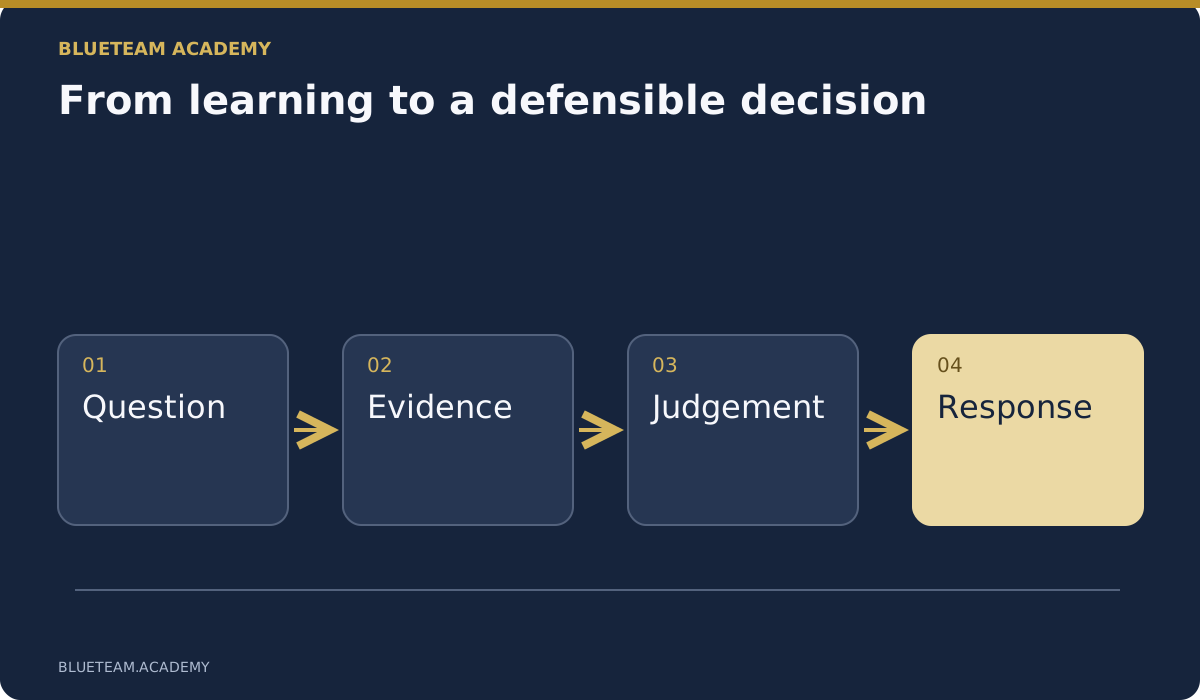
Cyber security blue team training should change what happens when something suspicious reaches your team. An analyst should be able to identify the question, examine the available evidence, explain what remains unknown and recommend a proportionate next action. A responder should be able to carry that decision through containment and recovery, with appropriate authority and verification. A manager should be able to distinguish a completed training assignment from a demonstrated improvement in those abilities.
If your team needs a structured route into that work, explore AI-Assisted Incident Response & Investigation. Use the course outline to compare the skills below with your team's responsibilities, prerequisites and current gaps. The aim is to select useful practice, rather than buy another collection of videos that nobody connects to the working day.
Begin with a concrete outcome. “Improve security awareness” is too broad for a SOC development plan. “Assess a suspicious account session, preserve the relevant records, identify affected resources and recommend a justified containment action” gives you something observable. It also reveals dependencies: the analyst needs access to logs, the responder needs an approved action path, and the service owner needs a way to confirm business recovery.
Write three to five outcomes before looking at course names. Ask a senior colleague to describe the evidence they would accept for each. That may be a reproducible timeline, a short decision note, a tested detection change or a recovery record. These examples become the standard against which you evaluate training providers, exercises and the learner's final work. The certificate can record completion; the work shows what completion meant.
2. Build a shared foundation, then train people for their roles
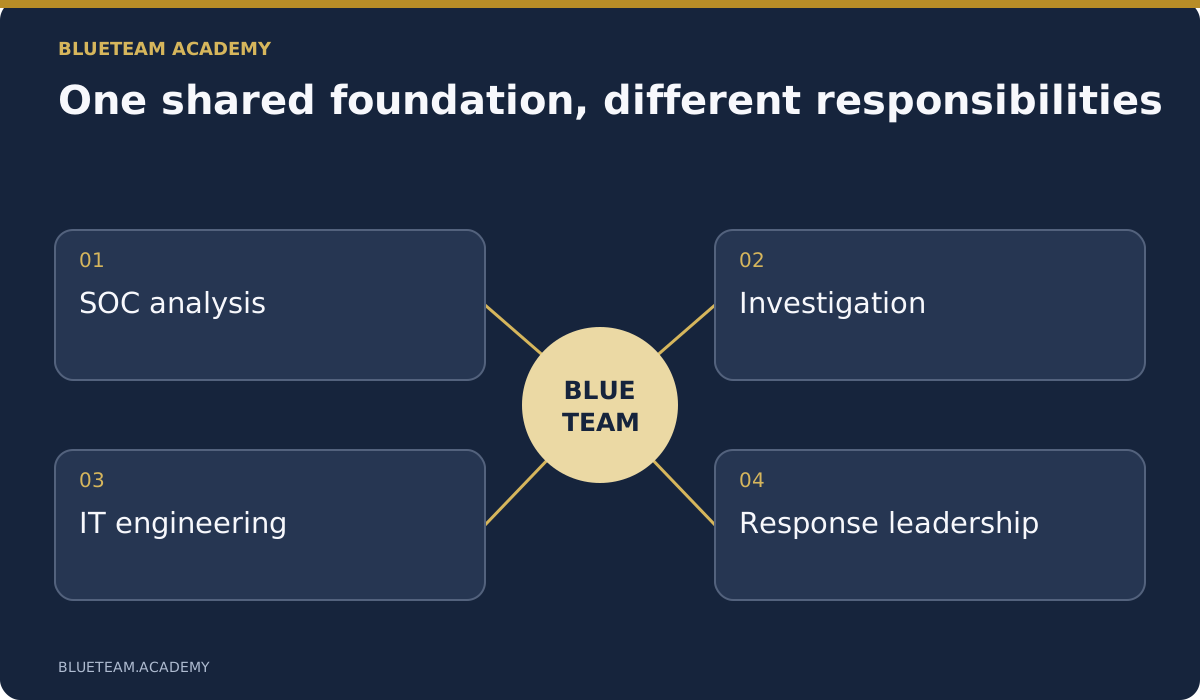
A blue team is a collection of responsibilities, not a single job description. A junior analyst, a Windows administrator, an incident commander and an application-security engineer may investigate the same event from different positions. Giving everyone identical material can waste experienced people's time while leaving beginners without the foundations they need. Separate a common working language from the deeper capabilities required for each role.
The common foundation should cover identities, endpoints, network connections, application behaviour, timestamps and the difference between an observation and an interpretation. People should understand why a successful sign-in does not prove that the rightful employee initiated it, and why a clean scan does not establish that no compromise occurred. They should also know when to stop guessing and request another source or a colleague's expertise.
Then specify role outcomes. SOC analysts need triage, evidence correlation and clear escalation. IT engineers need to recognise unsafe configuration, preserve useful records and implement authorised fixes without destroying evidence. Investigators need hypotheses, collection priorities and reliable case notes. Response leads need decisions, communication, dependencies and recovery criteria. Detection engineers need representative data, test cases and a way to measure the effect of rule changes.
The NIST NICE Framework describes cybersecurity work through tasks, knowledge and skills. Use that distinction to improve your own training brief; you do not need to turn it into a large mapping exercise. For each learner, record their current responsibility, one important task they struggle with, and the evidence that would demonstrate improvement. Review overlap between roles too. A technically excellent analyst who cannot hand over a case still creates work for the next shift.
3. Teach an investigation process that survives a change of tools
Knowing where to click in a console is useful, but the console cannot decide what question matters. A good investigation starts with a bounded problem: what happened, to which identity or asset, over what time period, and with what possible business effect? Define the first question narrowly enough that evidence can answer it. “Was this session authorised?” is a better starting point than “Find everything bad in the tenant.”
Consider a fictional finance employee who reports an unfamiliar mailbox rule. Begin with the report, the rule's actual configuration and the available audit record. Check who or what created it, when it became active, and what messages it could affect. Compare that activity with relevant sign-ins and the employee's account of events. Keep competing explanations visible: an authorised workflow, an administrator's change, a compromised user session or an application's access might require different evidence and different responses.
Maintain a working timeline that separates event time from collection time. Record the source, timezone and query or export method. Attach a confidence statement to important conclusions. “The rule forwarded messages to this address” and “the attacker read all previous messages” are different claims. The second needs additional support. Learners should practise saying that a question is unresolved without making their report vague or evasive.
Introduce new evidence halfway through the exercise. Perhaps the suspected account was disabled before another relevant event, or the audit record identifies an application rather than the user. Ask learners to revise their explanation and collection plan. Reward the revision when it follows the evidence. Training that rewards only guessing a hidden attacker narrative teaches people to defend their first answer. Real investigative competence includes recognising when a persuasive explanation no longer fits.
4. Make logs, files and network evidence part of a connected case
Practical training needs evidence that learners can inspect independently. Suitable material can include exported identity events, endpoint records, application logs, a small packet capture and a filesystem timeline. The important feature is not the volume of data. It is whether the exercise provides a clear question, enough context, and a defensible route from source material to a conclusion. A hundred relevant records can teach more than an unexplained multi-gigabyte download.
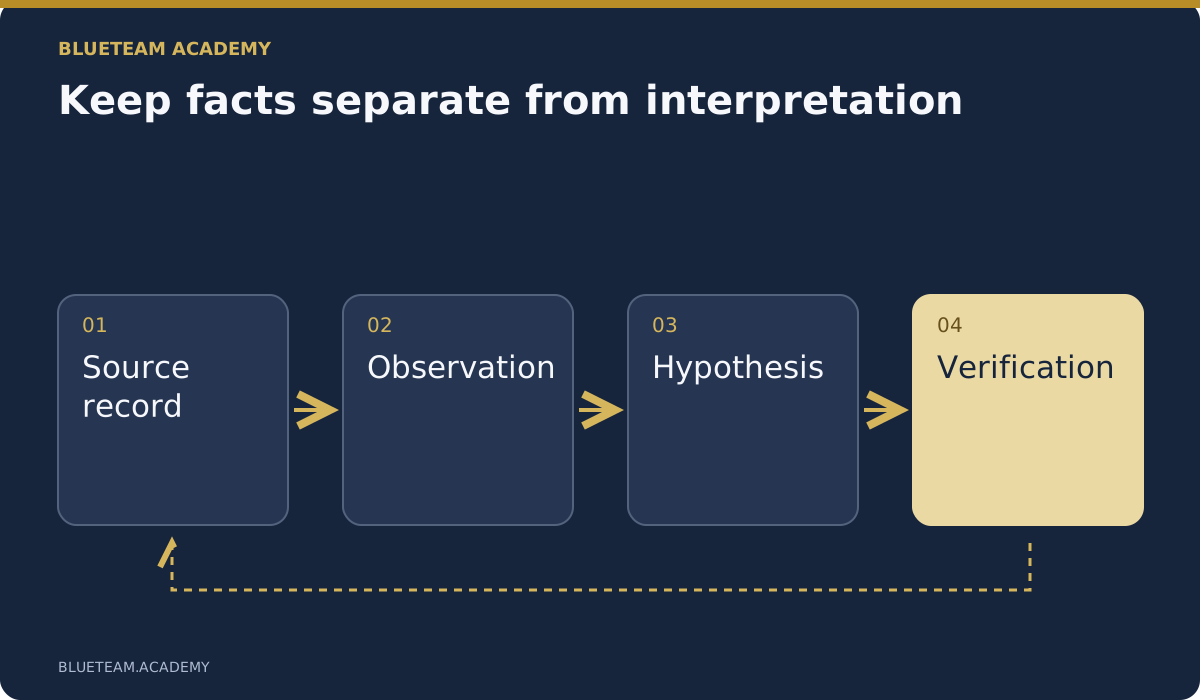
Keep original evidence separate from working copies and derived tables. Record hashes where useful, but explain their limit: a matching hash shows that the bytes match the recorded value; it does not prove that the original event was genuine or that the collection was complete. Include acquisition details, filters, retention gaps and known limitations. Teach the learner to ask what the dataset excludes before treating absence as reassurance.
For example, a connection in a packet capture may establish that two systems exchanged traffic. Encrypted payloads may prevent the learner from knowing exactly what was transferred. A file timestamp may support a sequence but need interpretation alongside the filesystem, clock and collection method. An alert can point to an event without independently proving the vendor's explanation. Exercises should make these distinctions practical through questions and counterexamples, not bury them in a disclaimer.
Use a small evidence register: identifier, source, collection time, relevant range, location and limitation. Ask learners to produce a finding that another person can reproduce from that register. Then change one condition, such as removing a log source or revealing a clock offset. The revised answer should become more precise about uncertainty. This is how evidence handling becomes part of analytical work rather than an isolated lesson on naming files.
5. Use AI to accelerate analysis without outsourcing judgement
Modern blue-team training should include AI-assisted work because analysts need a disciplined way to use the tools available to them. OpenAI, Claude and approved local models can help organise material, draft queries, suggest alternative explanations and prepare reports. The training objective is not to memorise a perfect prompt. It is to build a repeatable process in which the assistant's output can be checked against evidence and authorised actions remain under control.
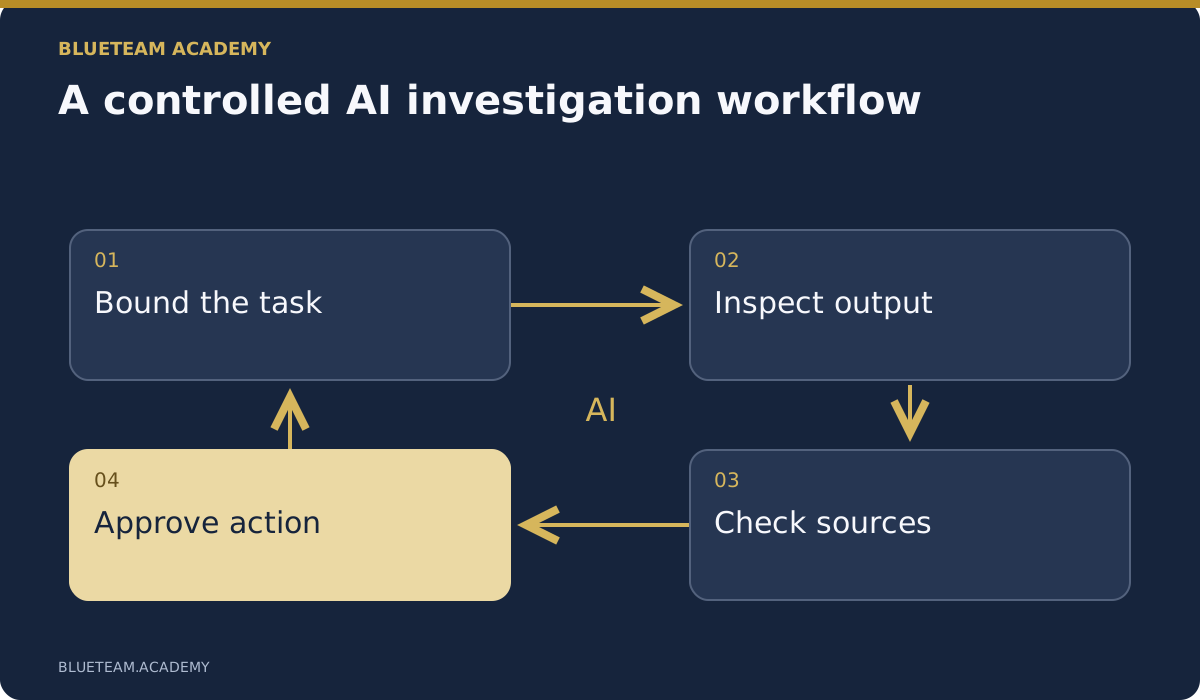
Start with an approved, bounded dataset. State its contents, the time range, the investigation question and what the assistant must not assume. Ask for a table of observations with source identifiers, followed by hypotheses and missing evidence. Require the assistant to distinguish a record's literal contents from its interpretation. If it proposes a query or script, inspect the logic and run it against the training copy. Compare the output with a small manual sample before expanding the scope.
Challenge the first answer. Ask which conclusion has the weakest support, which alternative explanation fits the same facts, and which next collection would change the decision most. A useful exercise includes a plausible but unsupported AI claim. The learner must identify it, locate the relevant original records and correct the report. A second model can offer another view, but agreement between two models is not independent evidence that the claim is true.
Treat instructions inside emails, documents and logs as evidence, not authority over the assistant. A malicious message that tells an agent to ignore rules or export files must not expand the investigation's permissions. Limit tool access, use read-only collection initially, and require review before consequential changes. The OWASP GenAI Security Project covers risks involving LLM applications and agents. Apply the relevant principles to your investigation workflow, including the tools the model can call.
Finally, teach data handling explicitly. Only use services and accounts approved for the sensitivity of the evidence. Do not upload confidential logs merely because an assistant accepts a large attachment. Local hosting can keep a workflow on company infrastructure, but it still needs access controls, retention decisions, protected credentials and an accountable operator. The same evidence standard applies whether the model is remote, local, expensive or free.
6. Include containment, recovery and the consequences of action
An investigation exercise should not end when someone identifies the suspicious account. The team must decide what to do, who can approve it, and how to tell whether the action worked. A training programme that stops at identifying indicators leaves a gap precisely where technical decisions begin to affect customers, employees and business services. Response practice should make that transition explicit.
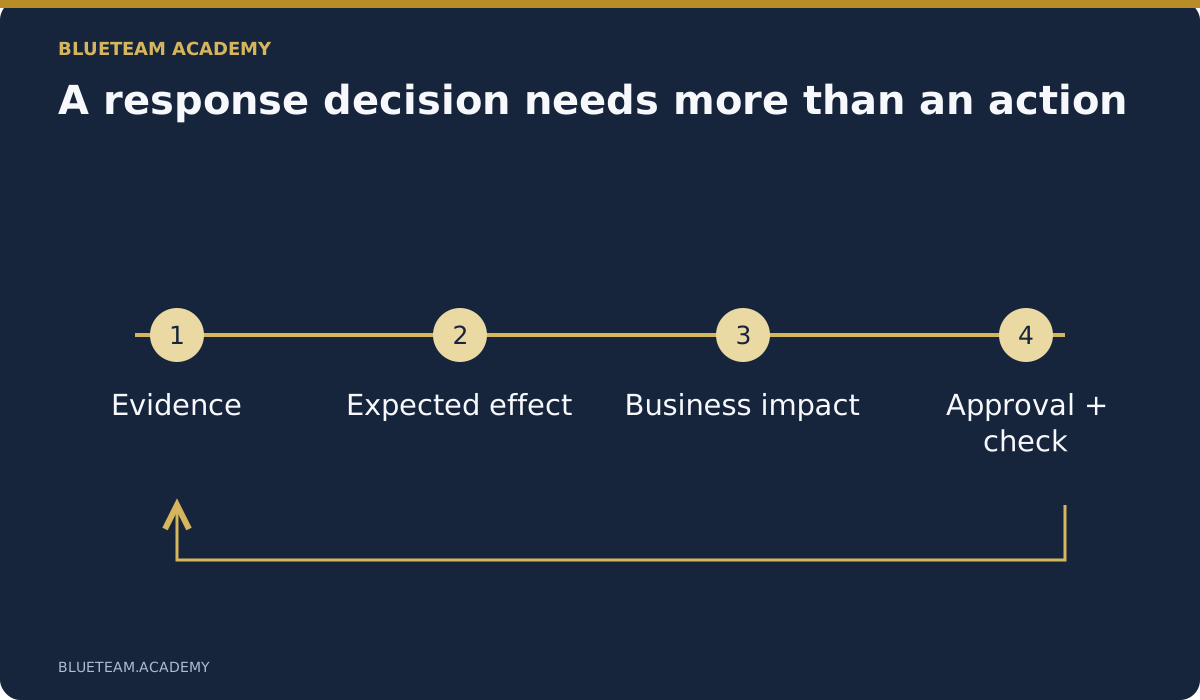
Use a decision record with six fields: current evidence, proposed action, expected benefit, potential disruption, approval and verification. For the mailbox example, distinguish disabling an identity, revoking supported sessions, removing an unauthorised rule and reviewing application permissions. These actions address different mechanisms. A password reset should not be taught as a universal remedy for every token, application or persistence scenario. The learner must explain what their chosen action actually changes.
Introduce a business constraint. The affected account might support a payment deadline, or a server might provide a service needed by several departments. This does not automatically justify leaving an attacker active. It means the responder should compare feasible options, explain the exposure and obtain the right authority. Use a simulator or an approved disposable environment to practise changes; a course should not casually direct learners to disable production users.
Recovery needs its own evidence. Confirm that legitimate users can work, the relevant access path is controlled, required monitoring is operating and the recovery has not restored the original weakness. Record who accepted the restored service and what remains under observation. NIST SP 800-61 Revision 3 connects incident response with wider cybersecurity risk management. For training, that means carrying lessons back into preparation, ownership and controls instead of treating case closure as the end of learning.
7. Cover cloud identity, applications and the systems the team operates
The training plan should reflect your actual estate. A team responsible for Microsoft 365 needs to understand identity, application access and the evidence available in that environment. A team running internet-facing SaaS products also needs to understand API authorisation, application audit events and deployment configuration. An endpoint-only syllabus may be valuable, but it cannot stand in for every defensive responsibility in a company built around cloud services.
Microsoft documents sign-in and audit logs as distinct sources in its Entra logging guidance. In an exercise, require learners to connect authentication evidence with the relevant change or resource activity. A location label alone is not a complete explanation of who acted or why. Ask what the identity could access, whether application permissions matter, and which evidence would support a claim of actual resource use.
For application teams, build a small scenario around an unauthorised cross-company API request. The developer should reproduce the failure, repair the server-side access decision and add a regression test. The responder should be able to identify the attempted and successful operations from useful audit records. Neither role benefits from a log that simply says “something went wrong” or dumps the entire request with secrets included.
Connect these responsibilities through joint exercises. The SOC identifies a suspicious sequence; the application owner explains expected behaviour; the engineer tests the access boundary; the response lead coordinates containment and verification. BlueTeam Academy's Microsoft 365 & Entra ID investigation course and Secure Software Development with LLMs address different parts of this work. Select them according to responsibility, rather than assuming every blue-team member needs to become a specialist in every platform.
8. Choose exercises with observable results and useful feedback
A runnable exercise needs more than an interesting story and a download button. It should state prerequisites, identify the files, describe the permitted environment, provide clear steps and explain what counts as a correct result. Learners need to know whether they are analysing fixed evidence, interacting with a simulator or testing a live system. These experiences can all be useful, but they prove different things.
Ask for a sample exercise before committing a large team. Can a learner set it up from the instructions alone? Are the commands compatible with the stated environment? Does a deliberately broken implementation fail for the intended reason? Can the learner repair it without deleting assertions? Does the expected result include both legitimate and denied behaviour? These questions expose shallow labs that look convincing in a demonstration but collapse when someone follows the instructions.
Keep feedback tied to reasoning. If an answer is wrong, explain which evidence was ignored, which assumption was unsupported or which control failed. Let the learner revise their work. Then test transfer with a slightly different case: a new identity, a different permission path, missing telemetry or an apparently reassuring AI summary. Repeating the same answer is not the same as applying the underlying principle.
Use MITRE ATT&CK as a vocabulary for adversary behaviour, not a scorecard of coloured boxes. Connect a relevant behaviour to the evidence you collect and the decision you can make. A technique label without a tested collection source or an actionable response offers little assurance. The exercise should finish with a short explanation of what was demonstrated, what remains untested and what the learner would do differently on a real system.
9. Turn the syllabus into a realistic 90-day team plan
A 90-day plan is a scheduling example, not a promise that everyone becomes an expert in three months. Adjust it for the team's starting point, shift coverage and available practice time. Protect study time in the rota. An assigned course with an impossible deadline usually produces rushed completion, avoidance or work outside paid hours. The manager should remove obstacles, not merely send more reminders.
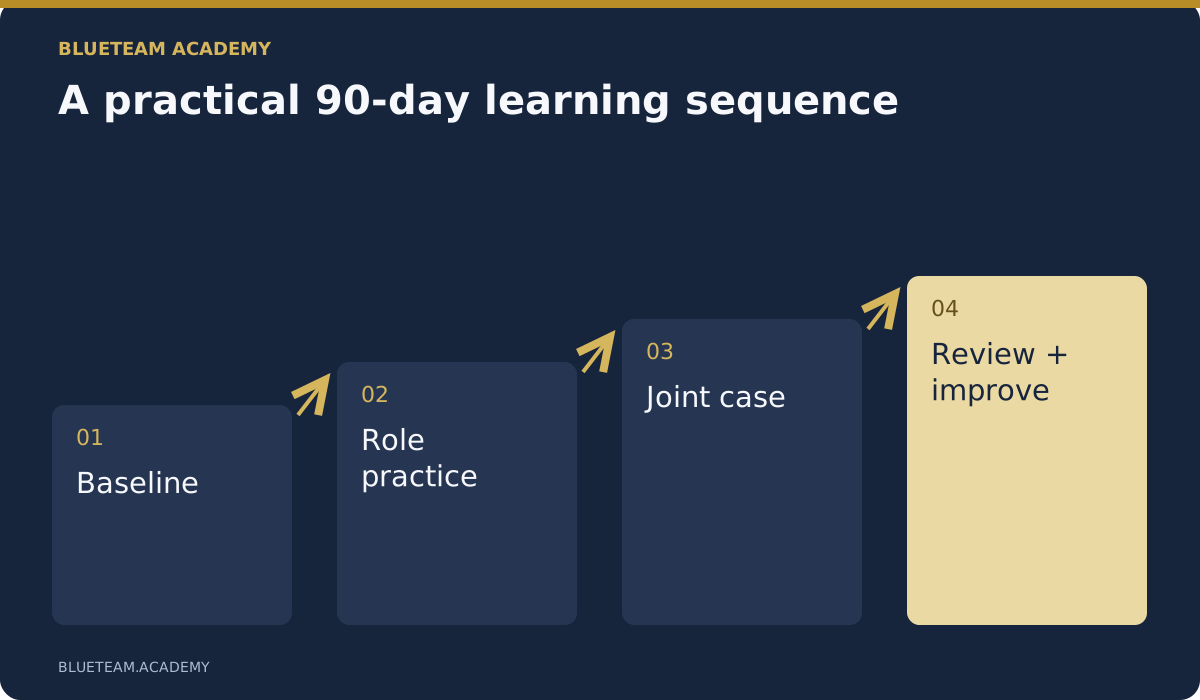
During the first month, establish a baseline and a shared investigation method. Give each learner a short unfamiliar case, ask for a finding and next action, and review the result. Select foundation lessons according to the observed gaps. Introduce the evidence register, timeline and decision note that the team will use throughout the programme. Agree who reviews work and how questions reach an experienced colleague.
During the second month, deepen role-specific practice. SOC analysts can work on correlation and escalation; investigators can develop alternative explanations; engineers can repair logging or access-control weaknesses; response leads can rehearse approval and recovery. Add an AI-assisted version of a task, then compare it with the baseline. Measure whether verification becomes better and more efficient, rather than assuming faster text generation means better analysis.
During the third month, run a cross-role case with a handover and a changing situation. Require a concise incident update, an approved response plan and evidence of recovery in the exercise environment. Finish with a retrospective: identify one process improvement, one telemetry gap and one learning priority. Give each action an owner and a review date. Continue with small recurring exercises after the programme; skills that are never used are difficult to sustain.
10. Measure capability, not just attendance or speed
Course completion data helps managers see who has started, who is overdue and who may need support. It should not be confused with proof that the person can handle an unfamiliar incident independently. Combine administrative progress with reviewed work samples and observed team practice. Keep the assessment proportionate to the role: a first-line analyst and an incident lead should not be judged against the same decisions.
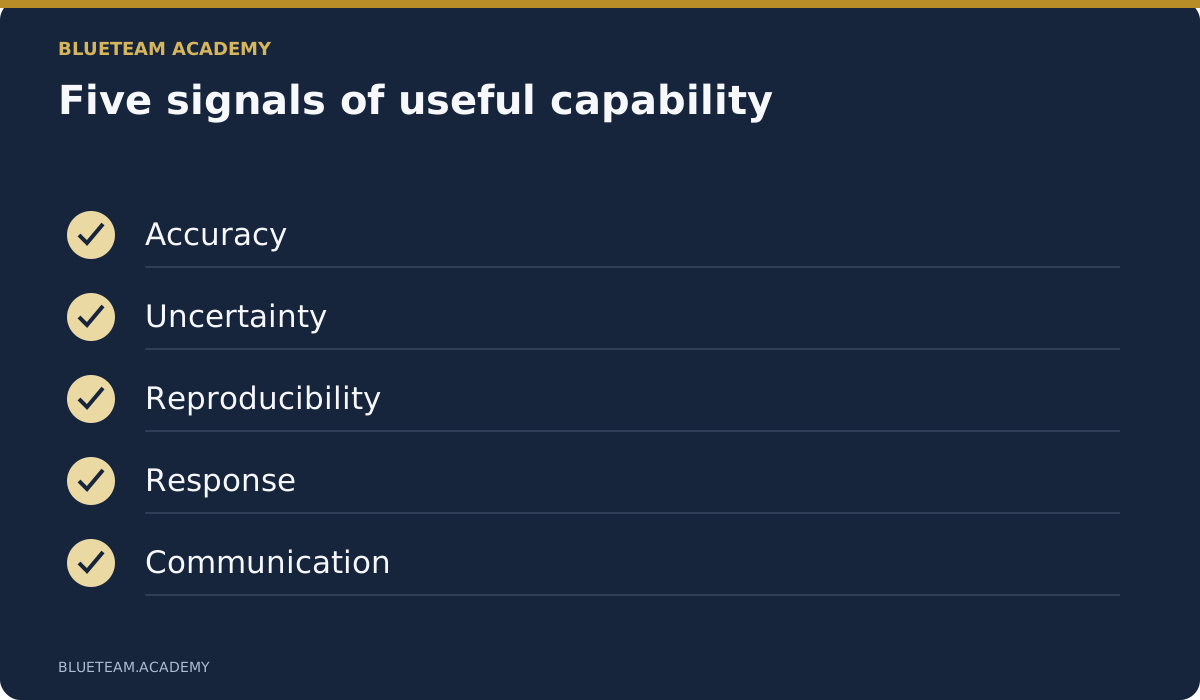
A practical rubric can assess five things: evidence accuracy, handling of uncertainty, reproducibility, response quality and communication. For each, define observable behaviour. Evidence accuracy means that claims match the cited records. Reproducibility means another analyst can follow the collection or query. Response quality includes the intended effect, authority, foreseeable disruption and verification. Communication means the recipient can understand the current situation and the decision required.
Be careful with speed. A faster closure can reflect improved skill, but it can also reflect omitted checks or an unjustified conclusion. Compare similar cases and inspect the quality of the work. If an AI-assisted analyst writes a report in five minutes but takes a colleague an hour to correct, the workflow has moved the cost rather than removed it. Reward concise, accurate reporting and timely escalation of meaningful uncertainty.
Use results to improve training and working conditions. Repeated mistakes may reveal missing access, unclear ownership or an unusable runbook rather than a lack of effort. Track whether the same gap recurs after coaching. Review a sample of completed work with the learner and agree the next practice task. This produces a more useful development conversation than ranking people by how quickly they clicked through slides.
11. What to ask before buying blue-team training
Compare the programme with the outcomes you wrote at the start. Request the current syllabus, prerequisites, a lesson sample and an example of the assessment. Ask which exercises are included, which require external accounts, and which costs sit outside the training price. A local evidence exercise and a cloud lab with paid services have different operating requirements. Your purchasing decision should account for both.
Check the delivery experience. Learners should be able to navigate clearly, resume their work and find transcripts and practice files without hunting through unrelated panels. Company administrators need a workable way to assign relevant courses and follow deadlines. Review accessibility and language coverage for the actual course edition you intend to buy; a translated marketing page does not establish that every technical lesson or narration is available in that language.
Ask how content changes are handled. When a provider adds a lesson, updates a workflow or replaces an assessment, what happens to existing progress? How are stale instructions and mismatched audio prevented? Do assessments require useful reasoning, or merely recognition of a phrase from the previous slide? Also distinguish a course completion certificate from an independently governed professional certification. If credentials matter to your organisation, examine the specific scheme rather than relying on the word “certified”.
Finally, pilot with a small group representing the intended audience. Include an experienced practitioner who can challenge the material and someone closer to the target entry level who can test the instructions. Review their outputs and the time they needed. Use that evidence to decide whether to expand. A provider's longest syllabus or largest image library is less important than a credible improvement in the work your team must perform.
12. Choose the next course by the problem your team needs to solve
Start with the gap that most often slows or weakens your response. If people can operate tools but struggle to connect evidence and justify conclusions, review Incident Response and Investigation. If the team needs a disciplined way to investigate and respond with AI assistance, start with AI-Assisted Incident Response & Investigation. The two needs overlap, but the learning emphasis is different.
If administrators need a stronger defensive foundation in the systems they run, consider Cybersecurity for IT Experts. For identity incidents, use the Microsoft 365 and Entra ID route. For developers responsible for the security and operability of a SaaS product, use the secure-development course. Broader phishing awareness can support employees' reporting and verification habits, but it should complement specialist investigation training rather than replace it.
Before enrolling the team, write a short learning brief: target responsibilities, prerequisites, available time, practice environment, expected work sample and reviewer. Tell learners why the work matters and where they can apply it. After the first exercise, ask which part of the real job now feels clearer and which obstacle remains. That answer is useful input for the next assignment.
Explore the technical course catalogue and compare the relevant outlines. Choose one practical outcome, assign the appropriate learning and review a real work sample afterwards. Cyber security blue team training earns its value when the next investigation has better questions, the next response has clearer authority and the next recovery has evidence that the service is safe to use again.
Frequently asked questions
Who should take blue-team training?
SOC analysts, incident responders, investigators and IT engineers can all benefit, but they need different learning paths. Start with a shared evidence and investigation foundation, then select practice that matches each person’s responsibilities and current experience.
Should beginners start with tools or investigation theory?
Combine basic technical understanding with small evidence-led exercises. A beginner should learn what a record means and what question a tool can answer. Advanced investigations are difficult to follow without identity, operating-system and network foundations.
Can we use our own AI subscriptions?
Where a course supports that workflow, use an approved service with the supplied training evidence. Check the exercise requirements and your organisation’s data-handling rules. Confidential incident material should not be uploaded to an unapproved account.
How long should a company training programme take?
Base the schedule on prerequisites, responsibilities and practice time. The 90-day example in this guide is a planning framework, not a guaranteed route to expertise. Narration duration does not include all investigation, repair and review work.
Does a completion certificate prove incident-response competence?
It records completion under the course’s requirements. Evaluate operational competence through reviewed evidence, unfamiliar scenarios, response decisions and team exercises. A course certificate is also distinct from a separate professional certification scheme.
Sources and further reading
Primary references for the framework and product concepts cited above. The scenarios, training plan and selection criteria are original practical suggestions.
- NIST — Incident Response Recommendations and Considerations, SP 800-61 Rev. 3
- NIST — NICE Framework
- MITRE ATT&CK
- Microsoft Learn — Sign-in logs in Microsoft Entra ID
- OWASP — GenAI Security Project
Educational guidance. Use approved environments and data. A course completion record alone does not establish operational competence.