The short answer
The best blue team cyber security certifications depend on the role: initial SOC work, incident handling, forensic investigation or a particular security platform. Pair any credential with practical exercises and reviewed work. BlueTeam Academy issues course completion certificates for eligible programmes; these are different from third-party professional certifications.
1. Start with the work, then choose the certificate
Blue team cyber security certifications can help a company give its defenders a shared foundation, recognise progress and identify people ready for more demanding work. They become an expensive distraction when everyone collects the same badge regardless of their responsibilities. The right starting point is a task your team needs to perform better: investigate an identity alert, decide whether to isolate a server, explain an uncertain finding, or check that recovery actually removed the attacker’s access.
For an immediately available company programme, explore Phishing Awareness: Microsoft 365, Google Workspace & AI Threats. It develops recognition, reporting and safer decisions around suspicious messages and requests. For deeper technical development, review the public Cybersecurity for IT Experts outline; that programme is still in development. An awareness course is a useful foundation, not a substitute for a professional SOC or forensic qualification.
This guide is for security managers, IT leaders and practitioners choosing a learning route. It compares several established credentials, explains what a completion certificate does and does not prove, and walks through the academy’s actual company administration and certificate options. Platform images use a local demonstration workspace with fictional people. They show the interface and an example PDF, not customer records or evidence that the pictured people earned a real award.
2. Course certificate, professional certification and practical evidence
A course completion certificate records that a named learner met the provider’s stated completion requirements for a particular programme. Depending on the course, those requirements may include lessons, exercises and a passing assessment. A professional certification belongs to a separate credentialing scheme with its own published examination, identity, renewal and award rules. Neither description, by itself, tells you whether the learning fits your environment. Read the requirements behind the document.
Keep three questions separate when evaluating a purchase. What will the person learn? How will that learning be assessed? What exactly will the issuer award? A recorded attendance session, an assessed course and an externally administered professional examination are different products. A digital badge can represent any of them. Its appearance is less informative than the issuing organisation, award criteria, assessment method and any expiry or renewal conditions.
There is also a fourth item that employers should ask for: a work sample. A short investigation timeline, a defensible containment plan or a carefully reviewed incident report shows how the learner applies knowledge. It does not replace a credential, but it makes the credential more useful in a development conversation. BlueTeam Academy certificates identify academy course completion. They are not presented as accredited qualifications, government approvals, third-party vendor certifications or guarantees of organisational compliance.
3. Match blue team training to the person’s responsibilities
A junior analyst needs to separate a concerning signal from an ordinary administrative event, gather the next useful records and escalate with enough context for someone else to act. An incident responder needs a broader view of scope, evidence, business impact, containment and recovery. A forensic specialist may need deeper work with host artefacts and timelines. An administrator needs to understand how apparently routine configuration choices create or close an attack path.
| Primary responsibility | Training emphasis | Useful evidence of learning |
|---|---|---|
| SOC triage | Alert context, corroboration and escalation | A concise case note with evidence references and next actions |
| Incident response | Scope, preservation, containment and verified recovery | A response plan with prerequisites, approvals and rollback |
| Forensic investigation | Artefacts, timelines, alternative explanations and uncertainty | A reproducible timeline and a qualified conclusion |
| IT operations | Identity, hardening, logging, dependencies and recovery | A justified control change and a validation record |
| Security leadership | Prioritisation, escalation, resources and decision quality | A decision brief that distinguishes facts from assumptions |
Write these expectations before comparing course catalogues. A practical goal might be: “After the programme, each analyst can explain why an unfamiliar sign-in matters, identify missing context and recommend a proportionate next step.” That is easier to assess than “complete twenty hours of cybersecurity.” The NIST NICE Framework offers a vocabulary of tasks, knowledge and skills for this kind of planning; using that vocabulary does not mean a course has NIST accreditation.
Team coverage matters as much as individual achievement. Sending every analyst to the same advanced specialty can leave nobody confident in incident coordination or basic evidence handling. Map the team’s responsibilities, identify weak handovers, and choose a small number of complementary learning routes. Then arrange paired exercises so that one person’s specialist knowledge becomes useful to colleagues rather than remaining an isolated qualification.
4. Four certification routes worth comparing
There is no single universally best blue team certification. The following examples illustrate different directions, not an ordered ranking or an exhaustive market list. Check the provider’s current objectives, assessment rules, access period, prerequisites and renewal terms before purchasing. Exam versions and commercial bundles change. BlueTeam Academy is a separate provider and does not issue these credentials or claim affiliation with their issuers.
| Credential | Published emphasis | When to investigate it further |
|---|---|---|
| Blue Team Level 1 (BTL1) | Junior defensive work, including phishing analysis, SIEM, forensics and incident response | You want a broad practical starting route for developing defenders. |
| GIAC Certified Incident Handler (GCIH) | Incident handling and understanding common attack techniques | Your role includes investigating and responding to active security incidents. |
| GIAC Certified Forensic Analyst (GCFA) | Advanced incident response, forensic analysis, memory and timelines | You need deeper forensic investigation capability and have suitable foundations. |
| Microsoft Security Operations Analyst Associate | Security operations with Microsoft technologies, including investigation, response and hunting | Your team works extensively with the Microsoft security ecosystem. |
Read an assessment blueprint as carefully as a sales page. Ask whether the exam requires selecting answers, performing tasks, interpreting supplied evidence, writing findings, or a combination. Also ask how candidates are identified and what assistance is allowed. These distinctions matter when deciding whether a qualification addresses a knowledge gap, a practical execution gap or an employer’s formal credential requirement.
Do not compare headline prices without comparing what is included. Training access, practice environments, examination attempts, extensions, retakes and renewal costs can differ. A cheaper preparation course may not include the external certification exam at all. Conversely, a specialist credential may be poor value for a person who will rarely use that specialty. Build your comparison around responsibilities and assessment quality first, then calculate the full cost for your specific cohort.
5. The capabilities a modern blue team needs beyond a badge
Effective defence requires more than recognising product names or memorising a framework. Analysts need to recognise the boundaries of their evidence. A suspicious file name is a lead, not proof of execution. An unusual sign-in location is a reason to investigate, not proof of account takeover. A quiet monitoring dashboard can mean that controls worked, that nothing happened, or that the required telemetry was never collected. Good training makes learners discriminate between these explanations.
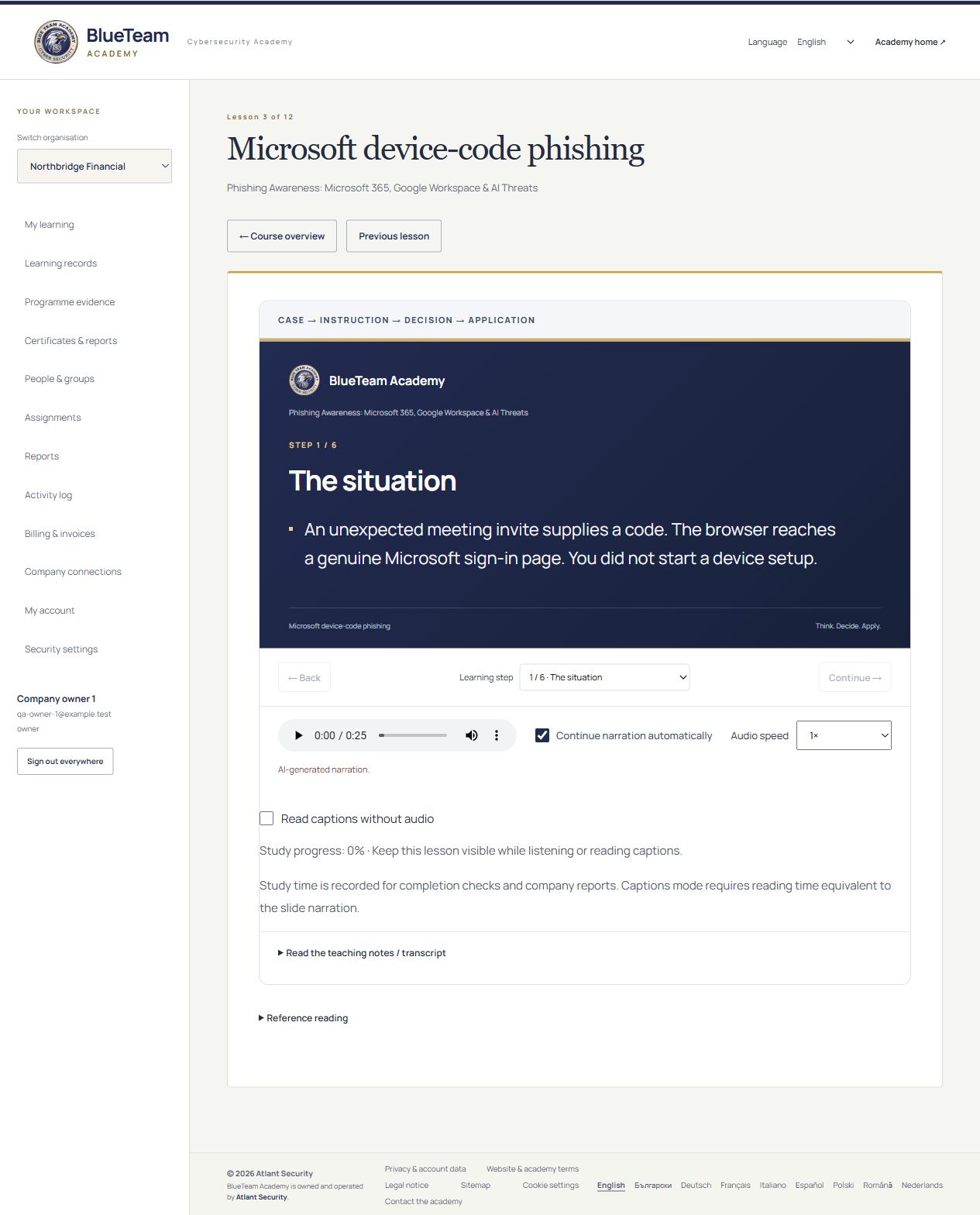
Look for exercises that connect several kinds of information: identity events, endpoint activity, network observations and business context. A person should be able to explain where a timestamp came from, which account or host it refers to, and what would change their conclusion. They also need to communicate missing information. “No matching event in the available export” is more accurate than “the action did not occur,” especially when retention and collection coverage are uncertain.
Response deserves equal attention. Identifying a compromised account is useful only if the responder can propose what happens next: preserve relevant evidence, obtain appropriate authority, interrupt the harmful access, check persistence and validate recovery. Training should include dependencies and failure cases. Isolating a production server can reduce attacker access while interrupting a business service. A useful exercise asks the learner to explain that trade-off and identify who can approve the action.
Finally, include handover. Another analyst should be able to pick up the case without replaying the entire conversation. Require a timeline, evidence references, confirmed facts, open questions, actions already taken and an explicit next decision. These habits are transferable between security products. They help both the person who earns a technical certification and the colleague who has strong operational experience but no new badge yet.
6. Evaluate AI-assisted analysis, not just prompt writing
AI can help summarise records, propose queries, compare hypotheses and draft incident reports. It also makes it easier to produce a confident explanation that outruns the evidence. A modern blue team learning plan should therefore test how a person scopes an AI task, protects information, checks the output and decides what the assistant is not authorised to do. Familiarity with a chat interface is not the same as investigative judgement.
A practical exercise starts with an approved, synthetic evidence pack. Ask the learner to give the assistant a specific question, define the available sources and require references for each material claim. Then ask the learner to reproduce the key observation independently. If the model says a particular account executed a command, the learner must find the relevant original record and verify that the fields support that statement. A plausible narrative without that check should not count as a sound finding.
Use the same discipline for proposed response actions. An assistant may suggest revoking sessions, disabling an account or isolating a device. The learner must identify the intended scope, required authority, business consequences, evidence-preservation needs and success checks. Keep exercise execution in the supplied simulator or authorised test environment. An AI-generated plan is not permission to change production systems, and a string saying “approved” is not a real approval.
When reviewing providers, ask how they handle sensitive evidence, prompt injection in untrusted documents, model mistakes and the difference between a demonstration and a real model run. Also check the rules of any external certification exam: permission to use AI in workplace practice does not establish permission to use it during an examination. Our AI Incident Response and Investigation outline describes a programme in development around investigation, verification and response with OpenAI, Claude and approved local systems.
7. Inspect the learning experience before buying at scale
A certificate is the end of a learning process. Inspect the process before buying a large company licence. Can a learner find the next lesson, understand the exercise and tell what remains before completion? Are the public description and private learning materials consistent? Can the company administrator identify which programme a person was assigned and which version they completed? A polished course cover cannot answer those questions.
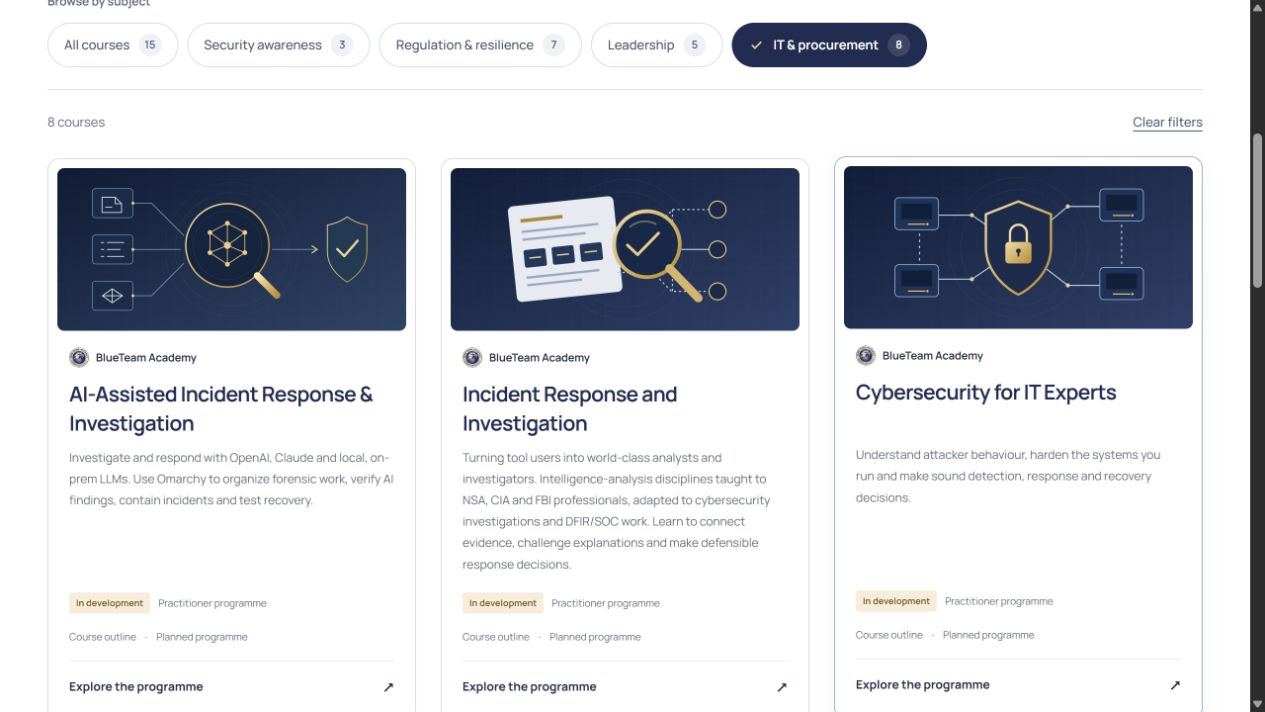
In the academy, public course pages distinguish available programmes from programmes in development. The technical outlines let you explore chapters and topics while their teaching remains in private drafting. The screenshots in this guide deliberately show the published platform interface and fictional records. They do not turn unfinished technical programmes into purchasable certifications. Use the course catalogue to check the current availability of the programme you need.
During a company pilot, include one learner who is new to the subject and one who already does the work. The first reveals unclear instructions; the second exposes unrealistic scenarios or missing assumptions. Have both explain one decision in their own words. Review accessibility, language availability and the suitability of any audio or captions for their actual working conditions. A pilot is most useful when it tests comprehension and administration together, rather than simply confirming that people can sign in.
8. Assign training, set a deadline and follow up
For a company programme, a repeatable assignment process is more useful than forwarding a course link and hoping people finish it. Company administrators can select available courses in their workspace, choose the intended audience and set a due date. The platform supports selecting individuals, groups or all active members; Microsoft directory selection depends on the company’s configured connection and permissions. Access still depends on the company’s course entitlements and learner limits.
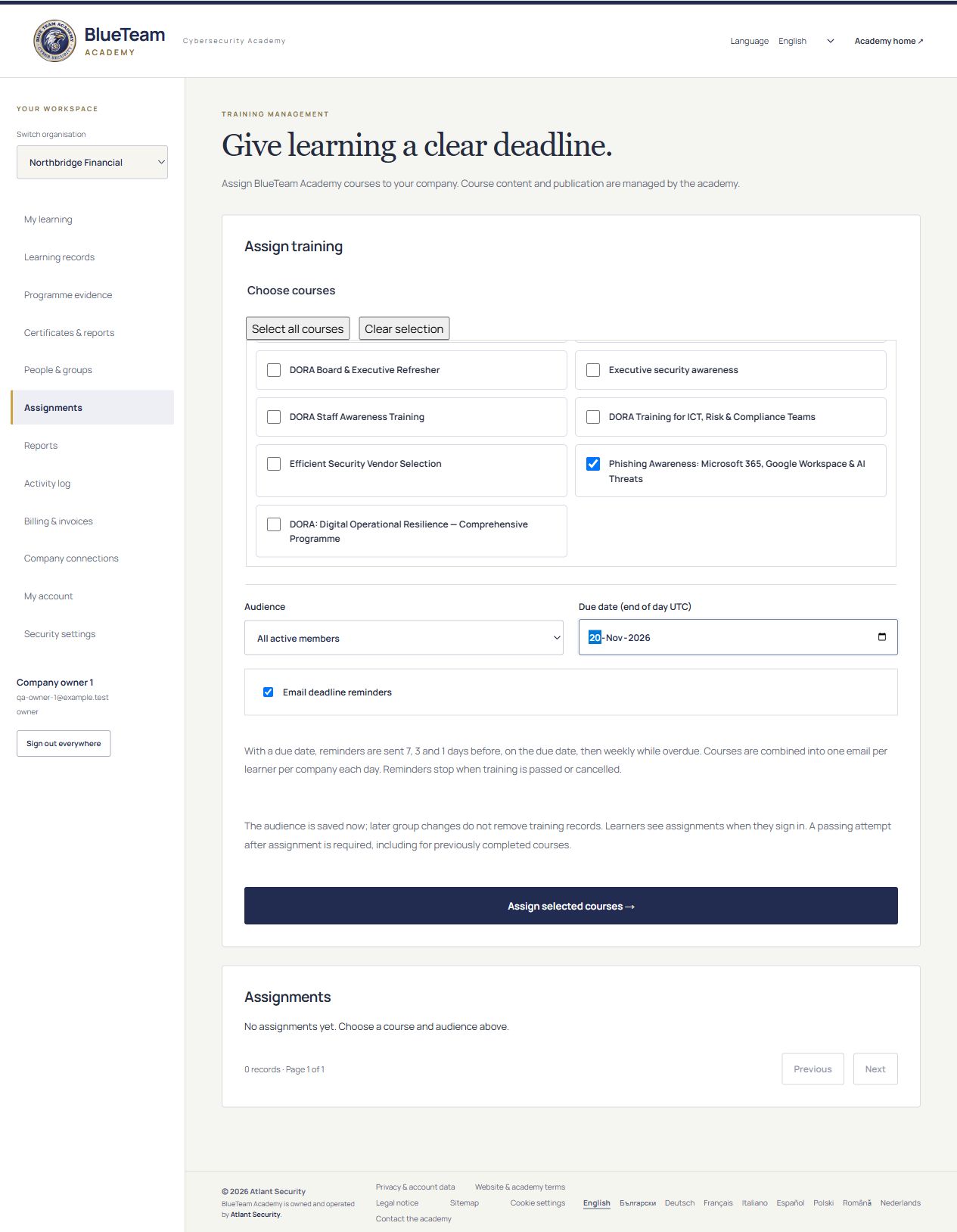
The assignment screen includes an email-reminder option. A deadline gives the administrator a clear follow-up point, but it should reflect real working time. Avoid assigning several demanding programmes with the same unrealistic date. Tell learners why the training matters, how much study time is reserved and what they should do if a question is unclear. The administrative record is strongest when the expectation is understandable to the people receiving it.
Separate overdue work from failed learning. A person may have had no protected study time, an access problem or an unsuitable course assignment. Review the status before deciding what intervention is needed. After completion, arrange a short team exercise that uses the newly learned approach in a realistic context. This turns the due date into the start of applied practice rather than the point at which the subject disappears until next year.
9. How the academy’s certificate issuing process works
For a programme that issues a certificate, the learner must meet that programme’s completion requirements and pass its assessment. Opening a course, enrolling in it or viewing its public outline does not create a certificate. Preview work is separate from learner completion. Requirements vary by programme, so administrators should read the course’s own completion and assessment information rather than assume that every training product has identical conditions.
- Assign the appropriate programme and confirm that the learner has access.
- The learner completes the required lessons and activities, including the applicable study requirements.
- The learner takes the assessment and meets the programme’s pass criteria.
- The platform records the successful attempt and the completion certificate data.
- An authorised administrator can find that completion in Certificates & reports and export the relevant document.
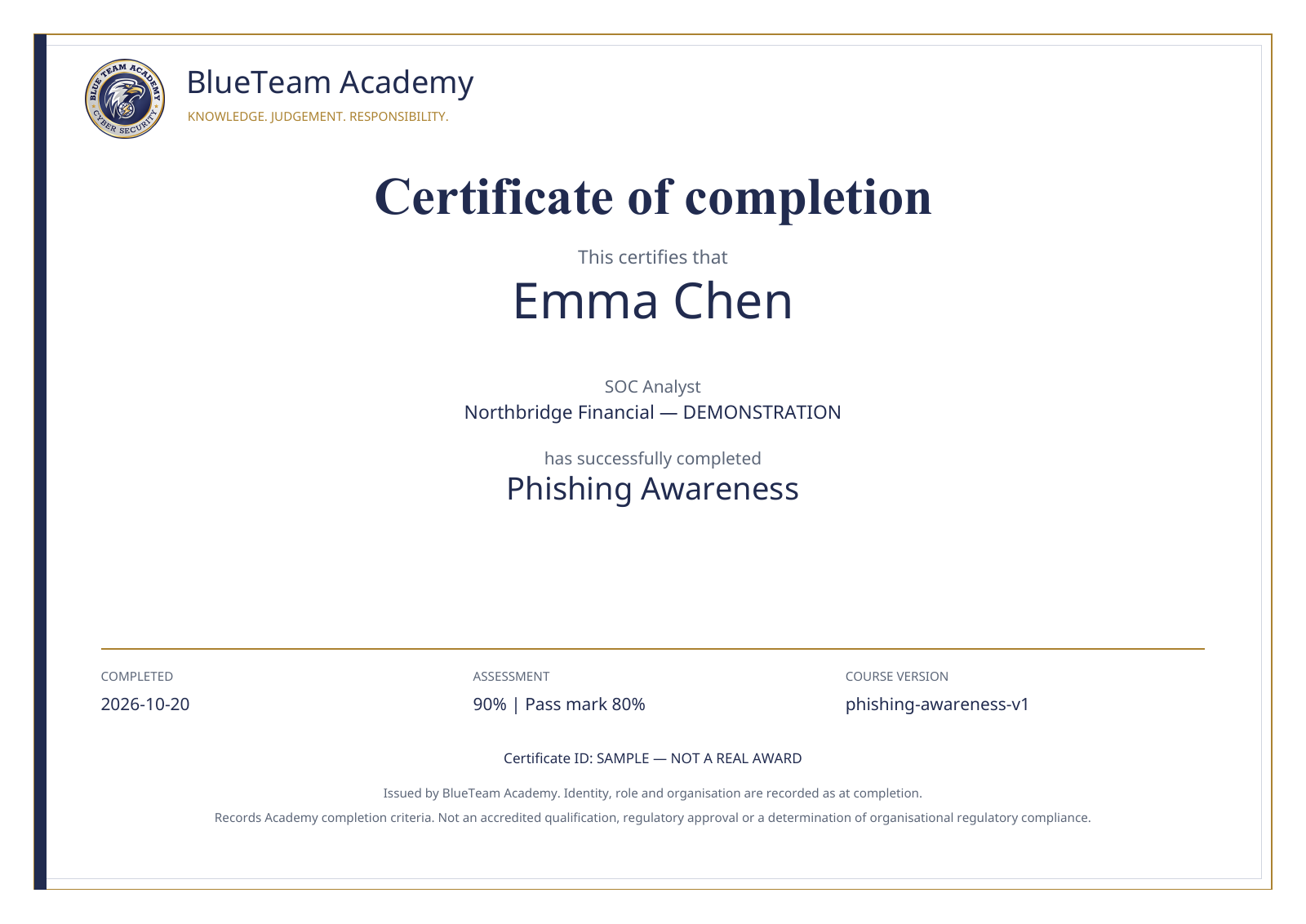
The named PDF includes the learner’s name, recorded role and organisation, course title, course version, completion date, assessment score, pass mark and certificate identifier. Those details help you interpret the record later. A certificate for one edition should not be casually described as evidence that the person completed a substantially different later edition. Keep the version and date together with the result when discussing refresher needs.
Completion tracking supports the process; it cannot read someone’s mind. Study time, slide engagement and assessment results are useful signals, not proof of independent professional judgement. Written reasoning and supervisor review can add context. If a learner rushes through or struggles to explain the material afterward, use that as a prompt for coaching and further practice. Do not assume that a downloadable PDF settles every question about capability.
10. Individual certificates, batch PDFs and company reports
The Certificates & reports area provides several outputs for different tasks. A manager may need one named certificate for a learner, a combined report for a training review, or a batch of individual certificates to distribute internally. These are separate choices in the interface. Use the search and filters first so the exported document corresponds to the people, programme, dates and completion history you actually need.
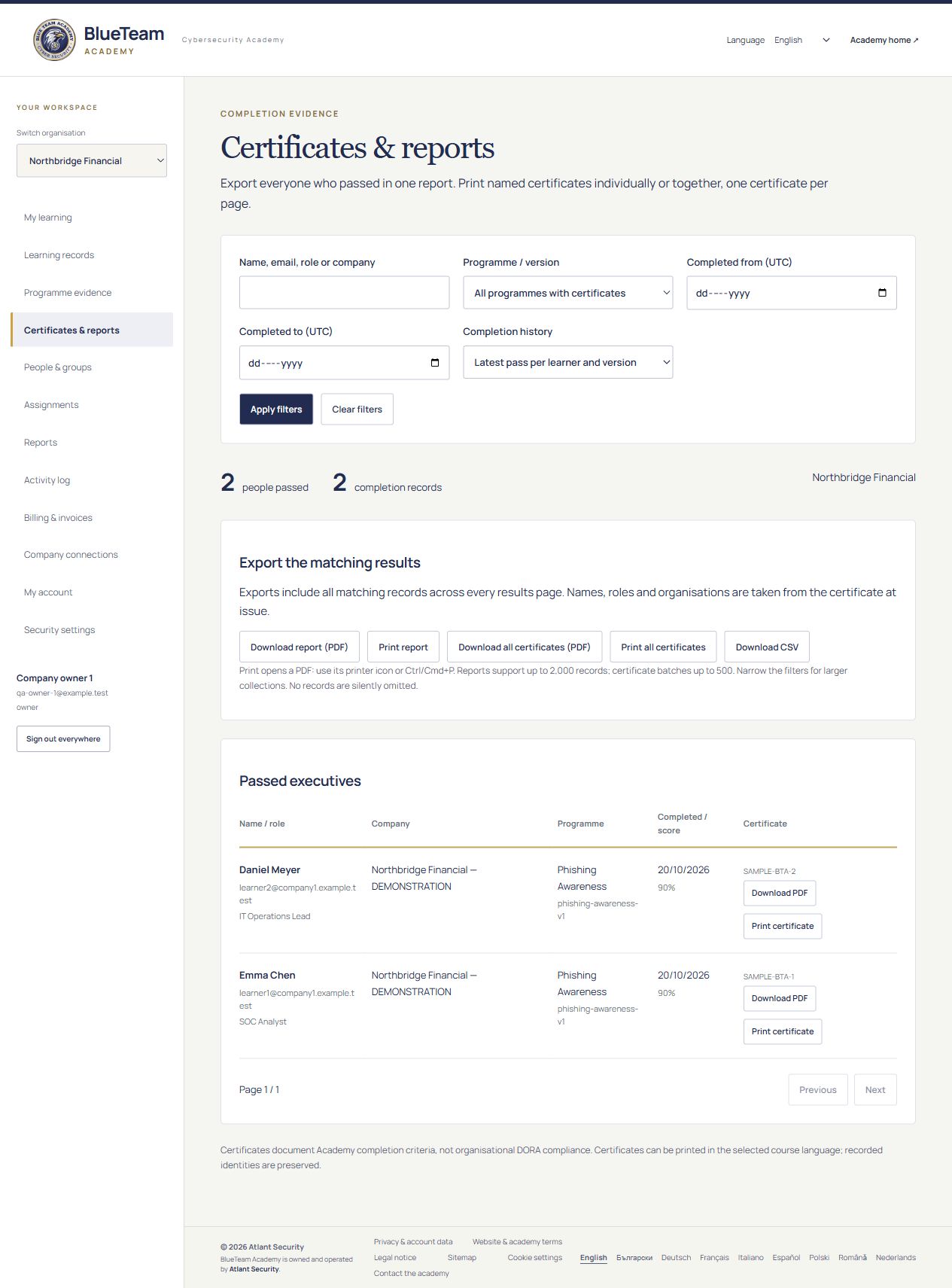
- Individual PDF: download a named learner’s certificate from the matching completion row.
- Individual printing: open that certificate and use the PDF viewer’s print control.
- Combined completion report: download or print the matching passed completions as one report.
- Certificate batch: download or print a combined PDF with one named certificate per page.
- CSV: export matching completion data for internal tracking and reconciliation.
Available filters include learner or company search, programme/version, completion dates and latest versus all passed completions. The export includes matching records across result pages. The platform places limits on document size: reports support up to 2,000 records and certificate batches up to 500. For larger cohorts, narrow the filters and export separate documents. The interface asks you to narrow the selection instead of silently leaving records out.
Store exports according to your company’s information-handling rules. Certificates and completion reports contain personal information, so a public shared drive is rarely the right default. Decide who needs the named record and who only needs aggregate progress. If your company keeps a central training register, record the course version and completion date there rather than retaining an unexplained collection of PDFs with inconsistent file names.
11. Build a company learning plan that produces useful evidence
A workable blue team certification roadmap can be simple. Start with a baseline exercise, identify a few concrete weaknesses, choose relevant training and repeat a comparable exercise afterward. For example, give analysts a small fictional identity incident and ask for an initial case note. Review whether they separate observation from inference, request useful follow-up records and explain a proportionate response. The result tells you more about training needs than a generic confidence survey.
For the first month, concentrate on foundations and shared vocabulary. During the next stage, give each role a relevant learning route and protected study time. Then bring the roles together in a scenario that requires a handover. Ask the analyst to explain the evidence, the administrator to identify operational dependencies and the responder to propose containment and recovery checks. This is an example planning sequence, not a claim that any team becomes professionally qualified in a fixed number of days.
Review improvement using a consistent rubric. Can another person reproduce the key finding? Are uncertainty and missing data visible? Does the proposed action address the actual suspected mechanism? Are approval, rollback and validation defined? Keep the initial and later work samples, a short reviewer note and the applicable completion evidence. Those records help you decide where a formal certification adds value and where targeted practice remains the better next investment.
Budget for the whole programme: course or exam fees, lab access where needed, study time, cover for operational shifts and review time. Select advanced certifications for people whose responsibilities justify them, rather than making an expensive specialist exam the entry ticket for every member of the team. Equally, do not expect a short awareness course to prepare a person for independent forensic work. Match the depth of training and assessment to the decisions they will make.
12. Choose your next step with BlueTeam Academy
Use the academy as part of a broader company learning plan. Published awareness and leadership programmes help establish shared understanding and documented completion. The technical catalogue also exposes outlines for deeper programmes under development, including Cybersecurity for IT Experts, Incident Response and Investigation, Microsoft 365 & Entra ID Incident Investigation, and AI Incident Response and Investigation. Their public outlines let you assess fit without implying that the draft lessons or certificates are already available to buy.
For a company ready to start with a published programme, review the Phishing Awareness course, then use the company demo to evaluate the learning experience and administration. For a technical development plan, contact the academy about your team’s responsibilities. Describe the work people perform, the incidents they face and the decisions they need to make more confidently. That information is more useful than simply asking for the largest possible catalogue.
Choose blue team cyber security certifications when the credential, assessment and scope fit a real need. Choose practical training when the immediate need is better performance on a specific task. Combine them where appropriate, retain clear completion records and keep practising after the certificate is issued. The objective is a team that can investigate, explain and respond with greater care—not a folder that contains more badges than the team can put to use.
Frequently asked questions
Which blue team certification is best for beginners?
Start with the work and prerequisites rather than a universal ranking. BTL1 is one practical junior defensive route to investigate. Compare its current syllabus and assessment with your baseline knowledge, available study time and target role. A beginner should be able to follow the underlying networking, operating-system and evidence concepts, not merely repeat the tools shown in a lab.
Does BlueTeam Academy issue professional third-party certifications?
BlueTeam Academy issues its own course completion certificates for eligible programmes after their completion requirements are met. It does not issue BTL1, GIAC or Microsoft certifications. The academy’s completion record and an external professional credential serve different purposes; choose the one that matches your requirement, or combine relevant training with a separately purchased external examination.
Can a company print certificates for everyone who passed?
Yes. Authorised administrators can filter passed completions and export a combined report or a PDF containing individual named certificates. Single-certificate download and print options are also available. Certificate batches support up to 500 matching records; larger groups should be split with filters. The screenshots show fictional demonstration records, not real learner awards.
Does a certificate prove that someone can handle a breach alone?
No. A certificate should be interpreted against its assessment scope. Pair completion evidence with reviewed practical work, supervised experience and the responsibilities the person actually holds. A useful evaluation asks the learner to explain evidence, uncertainty and response choices, including when to seek help. No short course can guarantee performance in every incident.
Should blue team training include AI tools?
Yes, where relevant to the role, but include verification and response discipline as well as prompts. Learners should practise defining bounded tasks, handling evidence safely, checking claims against originals and retaining human approval for consequential actions. Use synthetic data or an approved environment. Follow the separate AI rules of any external certification examination.
Sources and further reading
Provider documentation and the NIST NICE Framework. Check the issuer’s current syllabus and assessment rules before purchasing.
- Centri — Blue Team Level 1 (BTL1)
- GIAC — Certified Incident Handler (GCIH)
- GIAC — Certified Forensic Analyst (GCFA)
- Microsoft Learn — Security Operations Analyst Associate
- NIST — NICE Framework
Educational guidance. Course completion and professional certification are different; neither alone guarantees job performance.