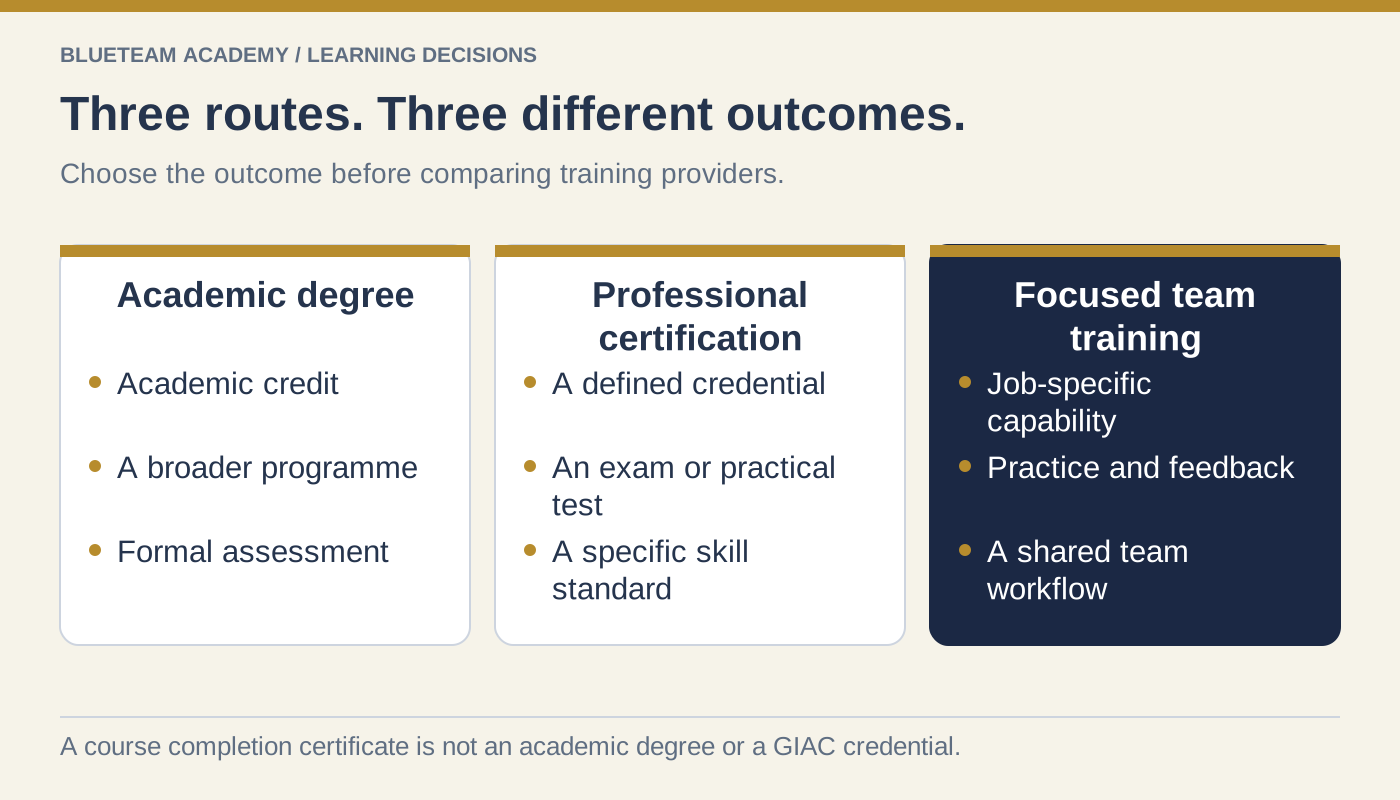
The short answer
There is no single substitute for every SANS offering. Georgia Tech and WGU are academic alternatives; HTB Academy, Centri BTL1, OffSec and TryHackMe offer practical professional routes. BlueTeam Academy is particularly strong for affordable team coverage and centrally managed learning. Compare credential type, practice, included access and total cost before choosing.
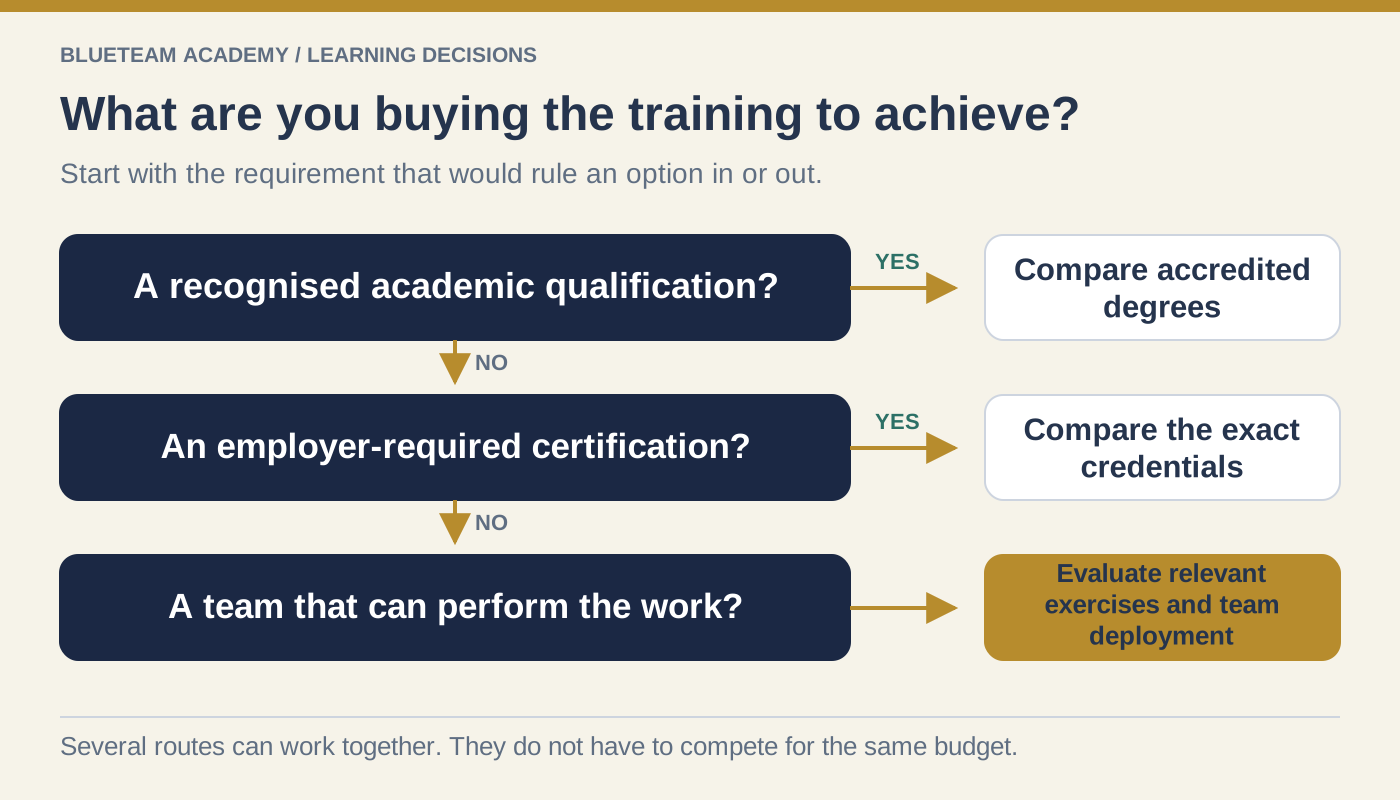
Start with the outcome you need to buy
Searching for SANS Technology Institute alternatives usually means one of two things: you want a respected cybersecurity qualification without the same tuition commitment, or you need to develop more of your team than a specialist training budget currently reaches. Those are different buying decisions. A university degree, a practical certification and an annual company training subscription can each be useful, but they do different jobs.
If your immediate priority is developing working defenders, explore BlueTeam Academy’s AI-Assisted Incident Response & Investigation course alongside the alternatives below. Compare what learners actually investigate, what they must verify and what they can take back to their next shift.
This guide compares seven options by credential, practical work, team delivery and total cost. The order is not a quality ranking. We publish this comparison and sell BlueTeam Academy courses; our recommendations reflect that perspective. We also explain where academic institutions and competing practical providers are a better fit. Prices and publicly described features were checked on 10 November 2026. Follow the linked provider pages before ordering, because fees, access periods and bundles change.
A useful training purchase starts with a sentence such as “our analysts must investigate a compromised account and recommend verified containment,” or “this engineer needs an accredited master’s degree for career progression.” Write that sentence first. It prevents a low sticker price from winning the wrong comparison, and stops a prestigious credential from consuming a budget intended to improve an entire team.
SANS.edu, SANS Institute and GIAC: compare the right thing
SANS Technology Institute, at SANS.edu, is the college. It offers academic degrees and certificates and describes its accreditation and authorization on its official accreditation page. SANS Institute, at SANS.org, provides professional training. GIAC provides certification examinations and credentials. A course completion certificate from another platform does not become a GIAC credential or an academic qualification because the topics overlap.
The current SANS.edu tuition page lists approximately US$54,000 for its master’s program and US$22,800 for most graduate certificate programs, with exceptions. Tuition includes course materials and GIAC tests used as course examinations. These are program prices, not a fair description of the price of every SANS training course. Admissions, individual circumstances, additional fees and the chosen program matter.
There is also an important correction to the claim that SANS cannot train teams: it can. Its group purchasing program offers volume discounts and centralized purchasing and administration. A fair alternative comparison therefore asks how much useful coverage your budget can buy, which learners need specialist credentials, and how the proposed training fits their work. It should not pretend that only inexpensive providers have enterprise features.
A quick comparison: seven alternatives, seven different reasons to shortlist them
Read the credential column before the price column. The table deliberately separates academic study from practical professional training. “Best fit” is our editorial assessment of the described offering, not the result of an independent examination of graduate outcomes.
| Option | Best fit | What you are buying | Main buying question |
|---|---|---|---|
| 1. Georgia Tech OMS Cybersecurity | A part-time university master’s | An academic degree program | Do the admissions requirements, specialization and study workload fit? |
| 2. Western Governors University | A flexible academic degree route | Competency-based degree study | How many paid terms are realistic for this learner? |
| 3. BlueTeam Academy | Budget-conscious team coverage and focused applied learning | Selected company courses or separately priced practitioner training | Which courses and learner allowance address the team’s actual responsibilities? |
| 4. HTB Academy | Structured technical paths and hands-on practice | Practical learning access and applicable certification pathways | Which tiers, labs and exams are included in the chosen plan? |
| 5. Centri’s Blue Team Level 1 | A junior defensive practical certification | Training and a practical certification assessment | Will the learner use the access period and prepare for the exam? |
| 6. OffSec IR-200 | A structured incident-response lab-and-exam route | Course access, practical work and an applicable OSIR exam bundle | Does the access window fit the learner’s work schedule? |
| 7. TryHackMe for Business | Recurring team practice and managed exercises | A business learning and exercise platform | What does the team quote include, and how will practice be scheduled? |
For an individual seeking a university qualification, start with the first two and compare them directly with SANS.edu. For a security leader trying to improve coverage across analysts, engineers and managers, begin with the practical options and a small pilot. These shortlists can coexist in one development plan.
1. Georgia Tech: a strong shortlist for an academic master’s
Georgia Tech’s Online Master of Science in Cybersecurity is a relevant alternative when the requirement is specifically an academic master’s degree. The university describes a 32-credit program, normally completed part-time over two to three years, with tuition of approximately US$12,000 plus mandatory semester fees. Check the current rate and your residency category rather than relying on older “under US$10,000” articles.
The attraction is the combination of university-level study, a substantial program and a considerably different tuition commitment from the published SANS.edu master’s figure. That comparison concerns academic tuition. It does not establish that the curricula, assessment methods, certification inclusions or student support are interchangeable.
Shortlist Georgia Tech when a colleague wants a sustained academic route and can meet its admission requirements and study demands. Ask them to explain which specialization matches their intended role and how they will protect study time during incident-heavy periods. An employee who is already managing a difficult on-call rotation needs a realistic workload agreement, not simply approval for tuition.
For employers, this usually belongs in an individual development or education-benefit plan. It is less direct as a way to teach fifty employees one shared reporting or response process this quarter. You can fund a degree for an emerging technical leader while using shorter team courses to improve the surrounding organization.
2. WGU: evaluate the degree and the number of terms
Western Governors University offers a different academic model, built around competency-based progression and six-month tuition terms. Its October 2026 tuition schedule lists US$4,425 per term for the B.S. in Cybersecurity and Information Assurance and US$4,925 for the M.S. These are tuition rates, not guaranteed total degree costs; check resources fees and other applicable charges separately.
The practical budgeting question is the likely number of terms. Existing knowledge, accepted transfer credit, available study time and assessment progress all affect the answer. A highly motivated employee may move efficiently through familiar material, but the business case should not assume the fastest completion story found on social media.
WGU is worth examining when the learner needs a degree and values flexibility in how they demonstrate competence. Review current admissions and geographic eligibility directly, particularly for applicants outside the United States. Also inspect the current program’s certification inclusions rather than assuming that every cybersecurity exam mentioned online remains included.
A useful employer agreement specifies protected weekly study time, an initial term budget, a review point and an evidence-based continuation decision. Keep the employee’s academic development separate from an operational team-training target. Completing a degree is valuable, but it does not automatically demonstrate that a group can coordinate a live incident together.
3. BlueTeam Academy: where affordability and team coverage stand out
BlueTeam Academy is our strongest recommendation in this comparison for buyers whose priority is affordable access for a wider team, central administration and focused applied learning. That is a judgment about the purchasing model and intended use, not a claim to replace a university degree or GIAC certification. If the requirement is an accredited academic award or a particular external certification, choose the appropriate credential route.
A company budget can reach more people
The published company plans currently start at €299 for up to ten learners for one selected eligible course per year. The other published allowances are €599 for up to 25, €999 for up to 50 and €1,499 for up to 100. Prices exclude VAT. Additional eligible company courses cost €149, €299, €499 or €749 per year respectively, depending on the learner tier. Practitioner courses use separate pricing; do not assume that every technical course is included in a company-plan allowance.
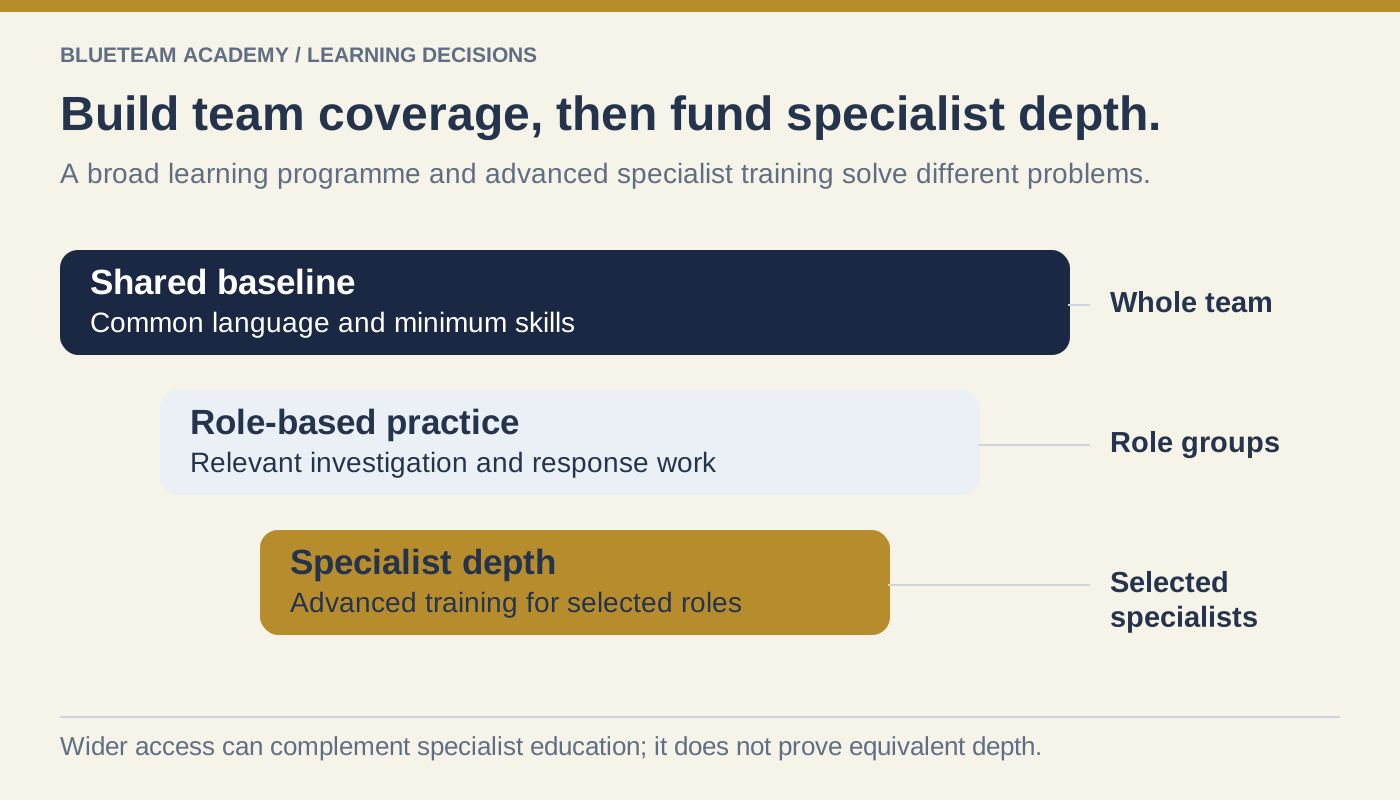
This makes broad coverage easier to budget. An organization can train the people who handle an issue day to day, their technical counterparts and the managers responsible for decisions. It does not have to concentrate the entire learning allocation on one employee. The advantage is particularly clear when the target is a shared foundation, consistent responsibilities or a repeatable process that many colleagues need.
Administration supports delivery at team level
Company administrators can assign courses, set deadlines and review progress. Microsoft 365 and Google Workspace single sign-on are included free across the published tiers. These features reduce avoidable coordination work when learners are spread across departments or locations. They do not make training self-managing: someone still needs to choose relevant courses, protect study time and review whether people can apply the learning.
Practical AI use can be evaluated in the curriculum
For technical teams, inspect AI-Assisted Incident Response & Investigation, Microsoft 365 & Entra ID Incident Investigation, Cybersecurity for IT Experts and Secure Software Development with AI/SI/LLMs. Match each course to the job: investigating evidence, responding to identity compromise, securing administered systems or developing a product securely.
The AI incident-response course emphasizes using OpenAI, Claude or an approved local model to examine evidence, challenge an explanation and support response work. Learners should not have to own every assistant or deploy an on-prem model to follow the core approach. The value to test in a pilot is whether they ask better questions, verify source records and make better-supported recommendations.
Understand the limits before buying
BlueTeam Academy provides self-paced learning and completion records under the course’s requirements. It is not an accredited college and does not issue GIAC credentials. Examine the specific course language, prerequisites, practical work, access terms and assessment before purchasing. A transparent choice is stronger than treating every certificate as equivalent. For eligible company training, the 30-day demo lets the setup administrator and one learner try one selected course without automatic conversion to a paid subscription.
4. HTB Academy: examine the technical path and its access scope
HTB Academy is a strong practical shortlist for learners who want structured technical paths and substantial hands-on activity. Its defensive offering includes a SOC Analyst path and the CDSA certification route. Assess the actual path and its prerequisites rather than choosing a platform because its overall catalogue is large.
Pricing deserves care because old help pages and search snippets can remain visible after a change. HTB’s October 2026 pricing announcement gives Silver Annual as US$550, €469 or £416, with defined tier access and bundled examination vouchers. Read the current package rules before budgeting. That is an individual subscription offer; an enterprise deployment should be evaluated against its own quote and terms.
The key questions are practical: can the learner work through the labs regularly, does the path cover the systems they defend, and will they use the examination attempt? Ask a pilot participant to explain one investigation to another analyst without relying on a walkthrough. That reveals whether the exercise produced transferable understanding.
HTB also has team offerings and AI-related capabilities, so those should not be presented as absent. BlueTeam’s case rests on its own pricing and curriculum fit. A company might reasonably choose HTB for a technically intensive learning path and a different provider for broader organizational training. Make the combination intentional rather than purchasing overlapping subscriptions without a schedule.
5. Centri’s Blue Team Level 1: a junior defensive certification route
Centri’s Blue Team Level 1, or BTL1, is worth examining for early-career defenders seeking a practical certification. Readers may know the provider as Security Blue Team; its former course address now redirects to Centri. The current page lists £399 for training and examination, approximately thirty hours of learning and four months of access, with a recommended experience range of zero to two years.
The published defensive scope includes phishing analysis, threat intelligence, digital forensics, SIEM and incident response. That creates a more focused comparison for a junior SOC analyst than placing a short professional course beside the total price of a graduate degree. The credential type and the learner’s starting point belong in the comparison.
For a manager, the access window is part of the cost. A four-month purchase is useful only if the employee can use it. Set aside recurring practice time and a realistic examination preparation period. Ask what the practical assessment requires and how the organization will use the resulting skills after the course.
BTL1 can be a sensible certification milestone within a wider development plan. It does not remove the need to learn the employer’s own systems, logging limitations and response authority. Pair externally assessed practice with a local exercise that asks the analyst to investigate a sanitized example from the technology stack they actually support.
6. OffSec IR-200: a defined incident-response lab and exam pathway
OffSec IR-200 is a relevant option for buyers looking for a structured incident-response course with a practical certification objective. OffSec describes thirty-four hours of content across thirteen modules, with exercises, a challenge lab and a pathway to its OSIR credential through an eight-hour proctored examination.
Study the syllabus for the balance you need: technical analysis, response decisions, communication and eradication. Then read the current pricing and access terms. Course-and-exam bundles, annual plans and promotions can change, so this guide does not treat a temporary discount as a permanent market price.
The buying decision is about more than recorded hours. A learner can spend considerable time on practical work, troubleshooting and preparation. Conversely, a long video catalogue does not by itself establish that an employee can handle an unfamiliar incident. Request a realistic study plan and judge the quality of the work the learner produces.
For teams evaluating AI-assisted investigation, ask an additional question: how will the chosen course and your internal practice teach analysts to use an approved assistant safely? Assess the actual current material rather than assuming a provider ignores AI. An established lab-and-exam route can coexist with focused practice on evidence preparation, source verification, agent permissions and response approvals.
7. TryHackMe for Business: recurring practice and team exercises
TryHackMe for Business belongs on the shortlist when the need is recurring technical practice with a team-management layer. Its published offering includes a SOC Simulator, threat-hunting and breach exercises, AI-driven tabletop exercises, custom content and management reporting. These are relevant capabilities for teams trying to make practice part of the working week.
Its business pricing guidance directs organizations toward a quote. Do not multiply an individual plan’s public price by headcount and present the result as an enterprise offer. Request the actual package, learner allowance, term, support and exercise inclusions.
A recurring platform works best when someone owns the practice program. Set a short weekly session, choose exercises relevant to the current role and hold a brief review afterward. The discussion should examine the decision and evidence, including unsuccessful approaches, rather than reward only a completion badge or a fast answer.
When comparing TryHackMe with BlueTeam Academy, include both the nature of the practice and the cost of reaching the intended audience. One organization may prioritize a simulation environment for its SOC; another may need inexpensive, centrally assigned courses for a wider mix of staff and managers. A pilot using the same operational outcome will be more useful than an argument about which platform has the most content.
Compare total cost and learner coverage, not unrelated price tags
A purchasing spreadsheet should show the currency, credential, access period, examination inclusions, learner allowance, tax treatment and expected staff time. Add travel where relevant, plus optional subscriptions or lab infrastructure. Keep USD, EUR and GBP separate unless you explicitly choose and date an exchange rate. A tuition figure and a company subscription are different units of purchase.
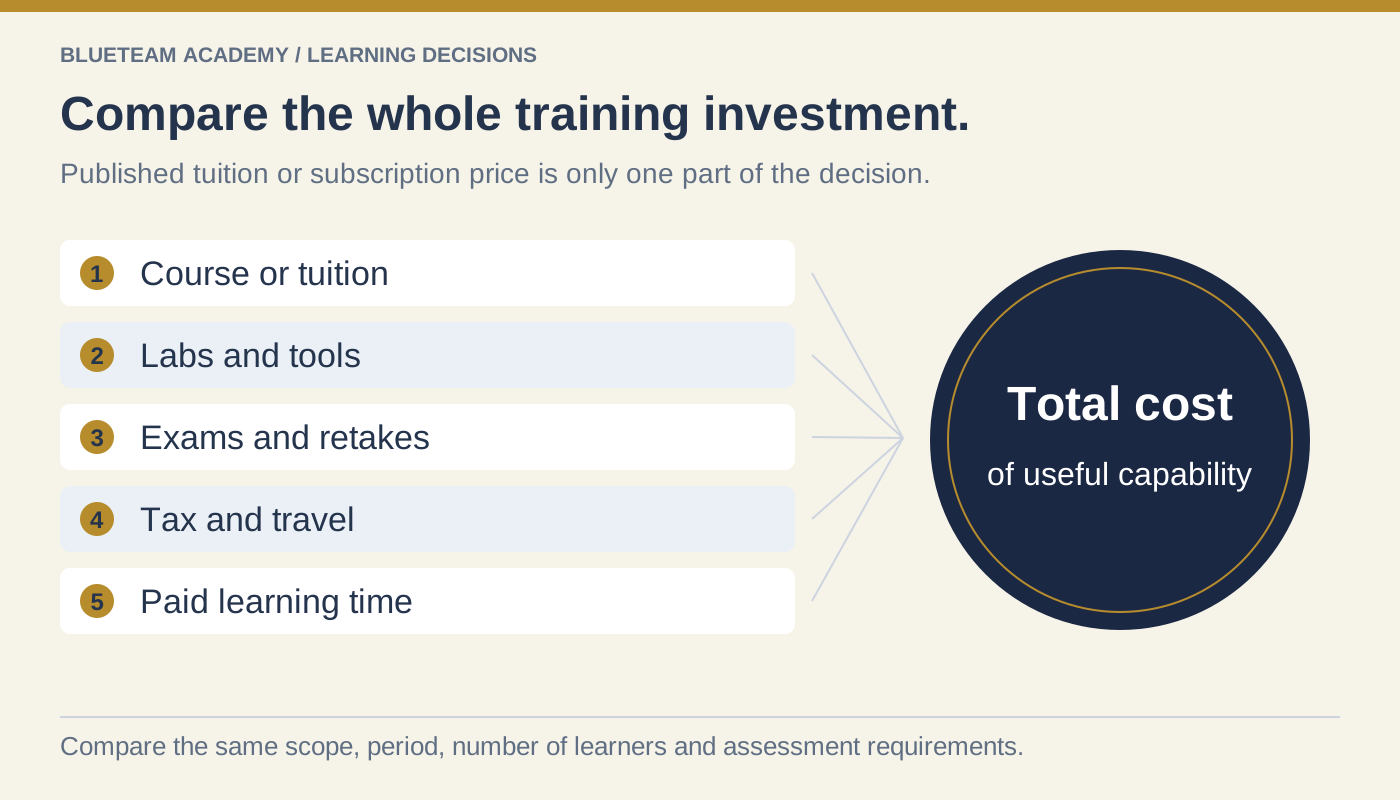
Here are transparent BlueTeam Academy examples using the current published eligible company-course plans at full utilization. They are arithmetic illustrations, not claims of equivalent academic or specialist-certification outcomes:
| Learners | One eligible course/year/company | Cost per learner/year at full use | Two eligible courses/year/company |
|---|---|---|---|
| 10 | €299 | €29.90 | €448 |
| 25 | €599 | €23.96 | €898 |
| 50 | €999 | €19.98 | €1,498 |
| 100 | €1,499 | €14.99 | €2,248 |
All figures exclude VAT. Fewer active learners increase the effective per-person cost. Technical practitioner courses may have different pricing. For example, one hundred learners taking three eligible company courses would cost €1,499 + €749 + €749 = €2,997 per year before VAT. That is €29.97 per learner at full use, for those three selected courses, not unlimited access to the entire catalogue.
This is where BlueTeam wins a meaningful criterion: the published company model can make broad coverage affordable without requiring every employee to buy a separate specialist training package. The correct SANS comparison is then an actual group quote for the proposed training and credentials, not an invented universal SANS price. Include completion rates and practical outcomes in the review so inexpensive unused seats do not masquerade as savings.
Match the route to the role instead of giving everyone the same course
A junior SOC analyst needs a different sequence from an experienced administrator or a software engineer. Start by identifying the decisions each person makes. A triage analyst should establish what triggered an alert and what evidence could support or challenge it. An administrator should understand how a compromised account or configuration can affect services. An incident lead needs to prioritize action, preserve useful evidence and coordinate recovery.
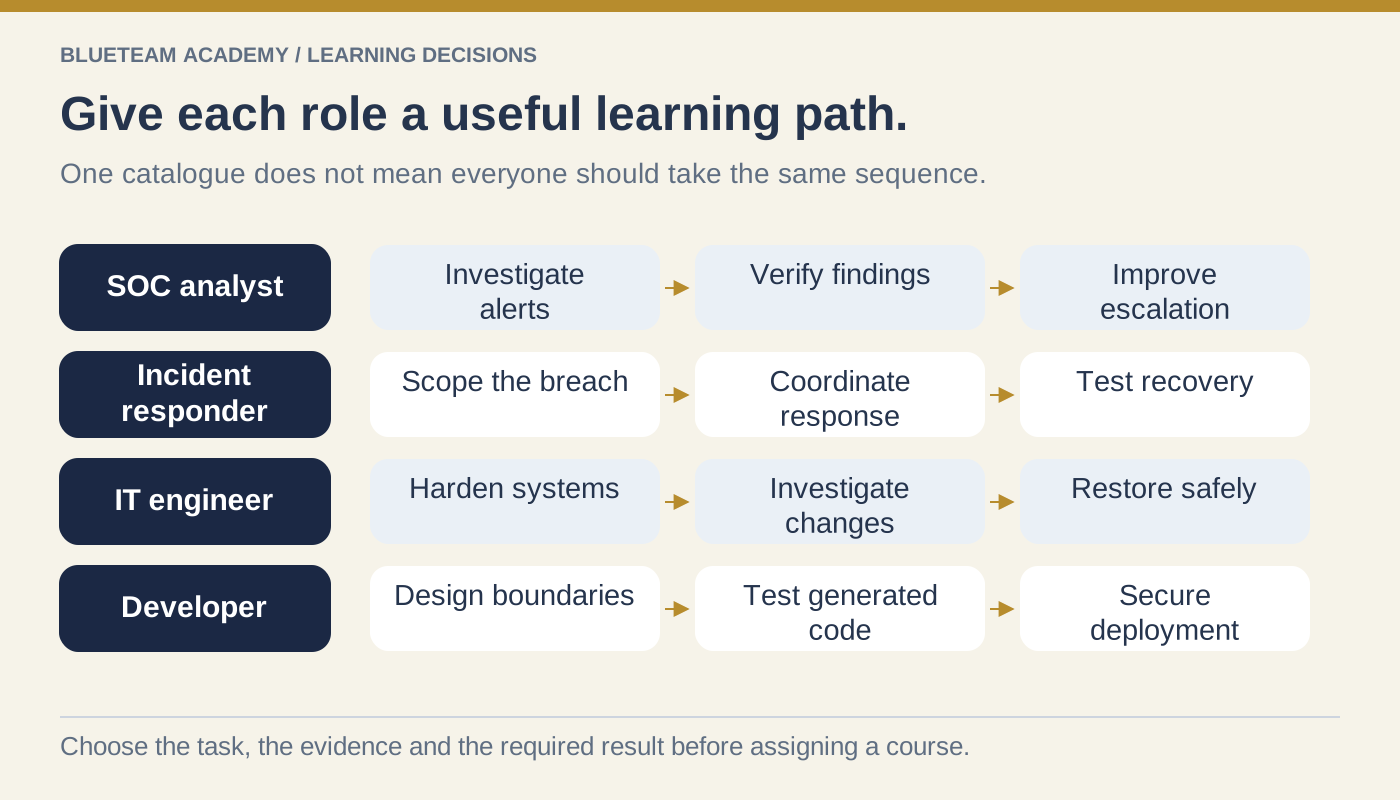
For a junior analyst, a practical foundation and a defensive certification route may be sensible. For an experienced investigator, targeted work on competing explanations, case notes and evidence-backed reports may matter more than another introductory syllabus. For an engineer developing software with AI assistance, security requirements, authorization, logging, deployment and release verification are directly relevant learning outcomes.
Give people a shared foundation where they collaborate, then separate the deeper paths. A security manager and an investigator should agree what a high-confidence finding looks like, even though the manager does not need to reproduce every technical collection step. A software engineer and a responder should understand what the application records and which response actions are safe.
BlueTeam’s breadth across company training and practitioner topics is useful here, provided procurement checks the pricing for each selected course. A specialist credential may still be the right investment for one or two people. Team development is often strongest when those specialists are surrounded by colleagues who understand the same evidence standards and escalation process.
Evaluate AI-assisted work through evidence, not product names
AI belongs in a modern cybersecurity training comparison, but the presence of “AI” in a title tells you little. Ask the provider to demonstrate a complete workflow. What information is supplied? Which question does the learner ask? What does the assistant inspect? How does the learner check the finding, and what response action follows?
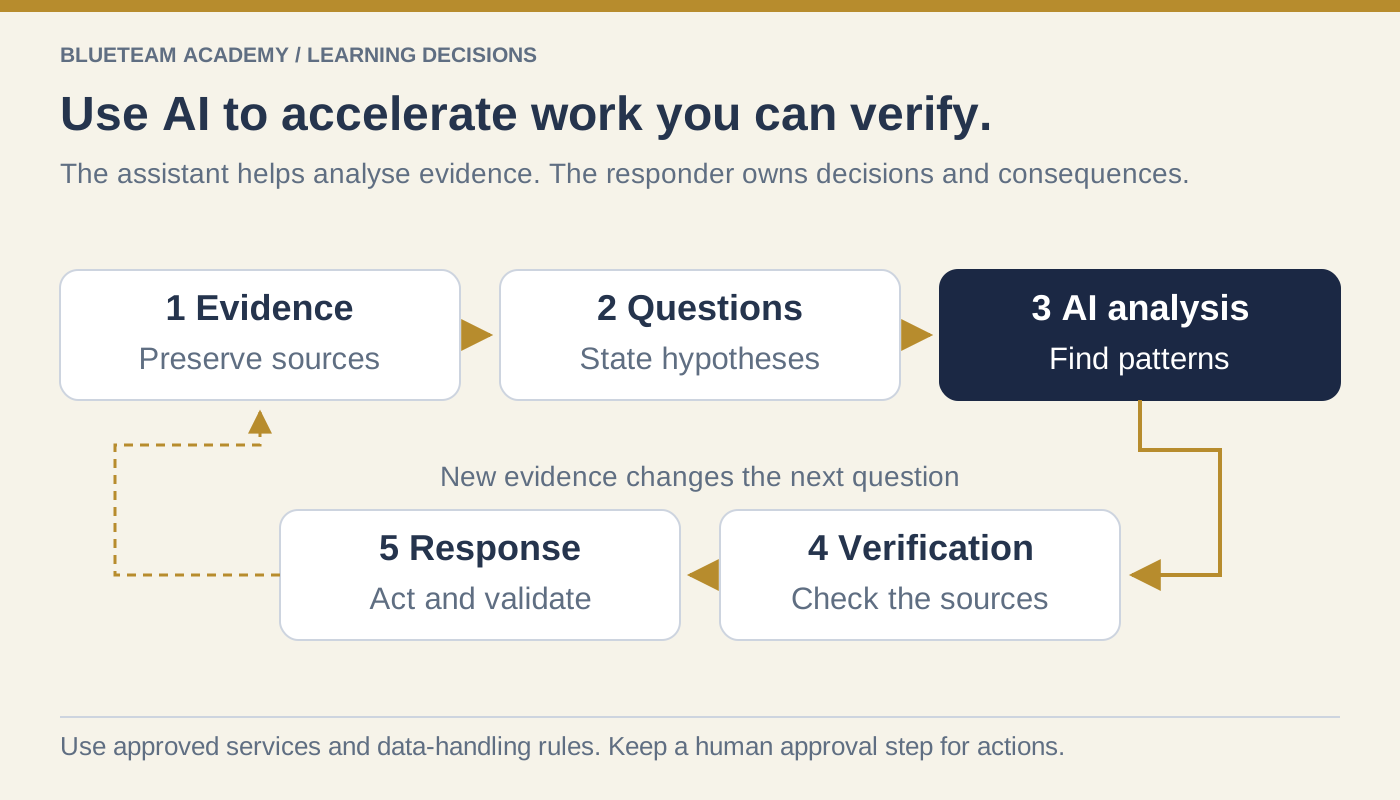
Consider a suspicious sign-in followed by a mailbox rule change. Useful practice provides the alert, account and device context, relevant timestamps and enough identity and mail records to investigate. The learner might ask an approved assistant to produce a timeline, identify the rule’s scope and show the original events supporting each claim. They must then distinguish a plausible interpretation from something the records establish.
A useful response exercise continues past the report. It asks which access or persistence mechanism needs containment, who can authorize the change, what must be preserved, how to test whether the unwanted behavior stopped and what would trigger rollback. The assistant can help plan and analyze those checks. It should not receive unrestricted production permissions because a learning task needs a dramatic finish.
For BlueTeam Academy, evaluate these ideas in the AI incident-response course outline. For any provider, check confidentiality rules, approved model choices, licensing assumptions and whether a local-model option is optional. SANS, HTB and TryHackMe also discuss AI capabilities; the fair question is which specific teaching workflow fits your team and produces work you can review.
A procurement scorecard that makes the decision easier to defend
Ask each shortlisted provider to demonstrate the same requirements. Use a small number of criteria with clear evidence rather than a complicated spreadsheet that rewards marketing copy. Your weights should reflect the reason for buying: academic recognition carries more weight in a degree decision, while practical outcomes and learner coverage may dominate an operational team program.
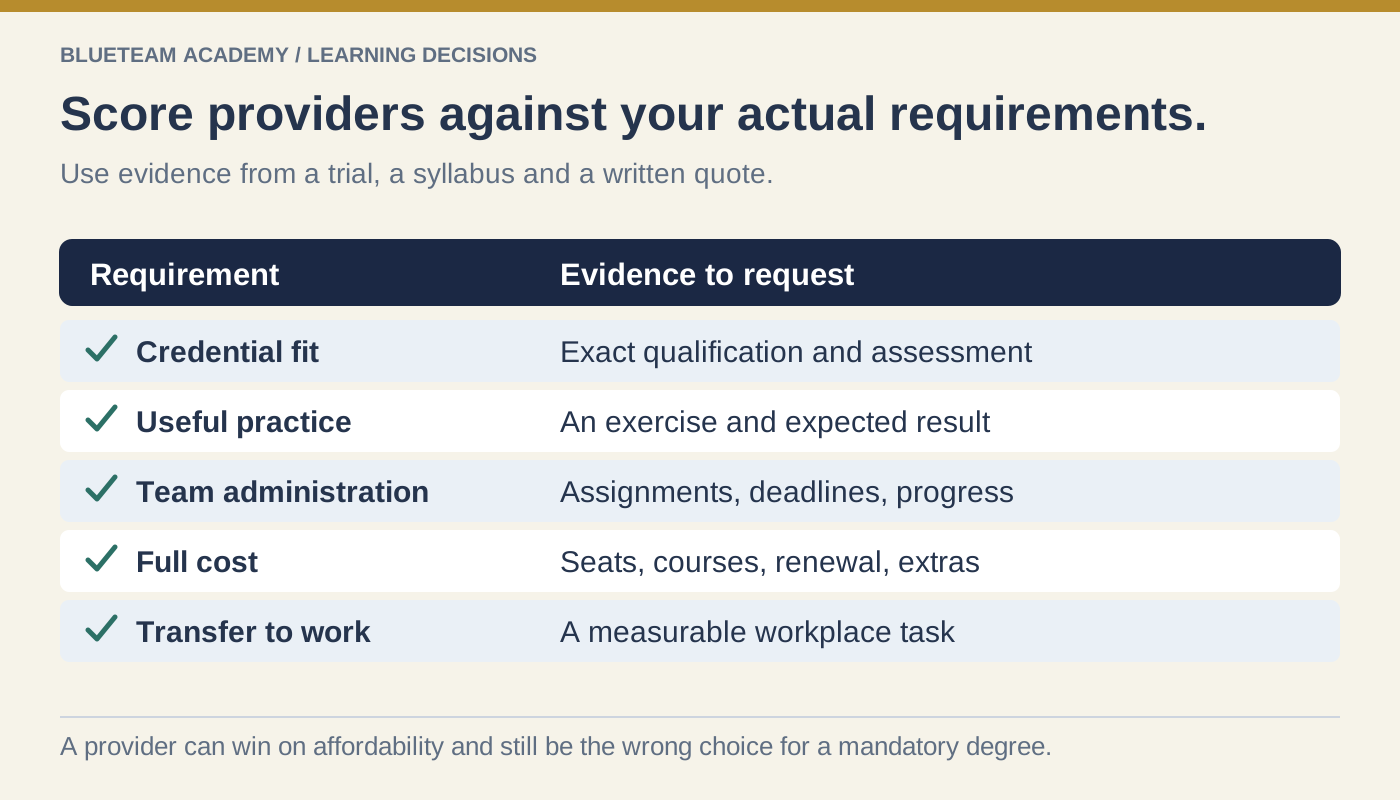
- Credential fit: identify whether the outcome is academic credit, a professional certification or a provider completion record.
- Practice quality: inspect a representative exercise, its starting context, evidence, expected work and feedback.
- Role fit: compare prerequisites and topics with the employee’s actual responsibilities.
- Team delivery: check identity integration, assignments, deadlines, reporting and administrative effort.
- Commercial fit: record included courses, seats, access windows, renewals, examination attempts, taxes and optional charges.
- Operational transfer: define the work product that will demonstrate improvement after training.
Do not award full marks just because a feature exists. Ask someone who will administer the program to try the workflow, and ask a learner to complete a real exercise. If the platform offers progress reports, inspect what “completed” means. If an assessment claims practical competence, understand how the work is evaluated.
For a budget-sensitive company, BlueTeam Academy can lead on affordable coverage and straightforward company delivery. For an academic qualification, evaluate academic institutions. For a named practical certification, evaluate that credential and its assessment. Making the criterion explicit allows different providers to win different parts of the same development plan.
A realistic 90-day rollout for a defensive team
Days 1–15: establish the baseline. Select one recurring operational problem, such as investigating suspicious account access. Record how the team currently approaches it, which evidence is available and where handovers fail. Select a few learners with different experience levels for the pilot. Include the person who will assign and track the training.
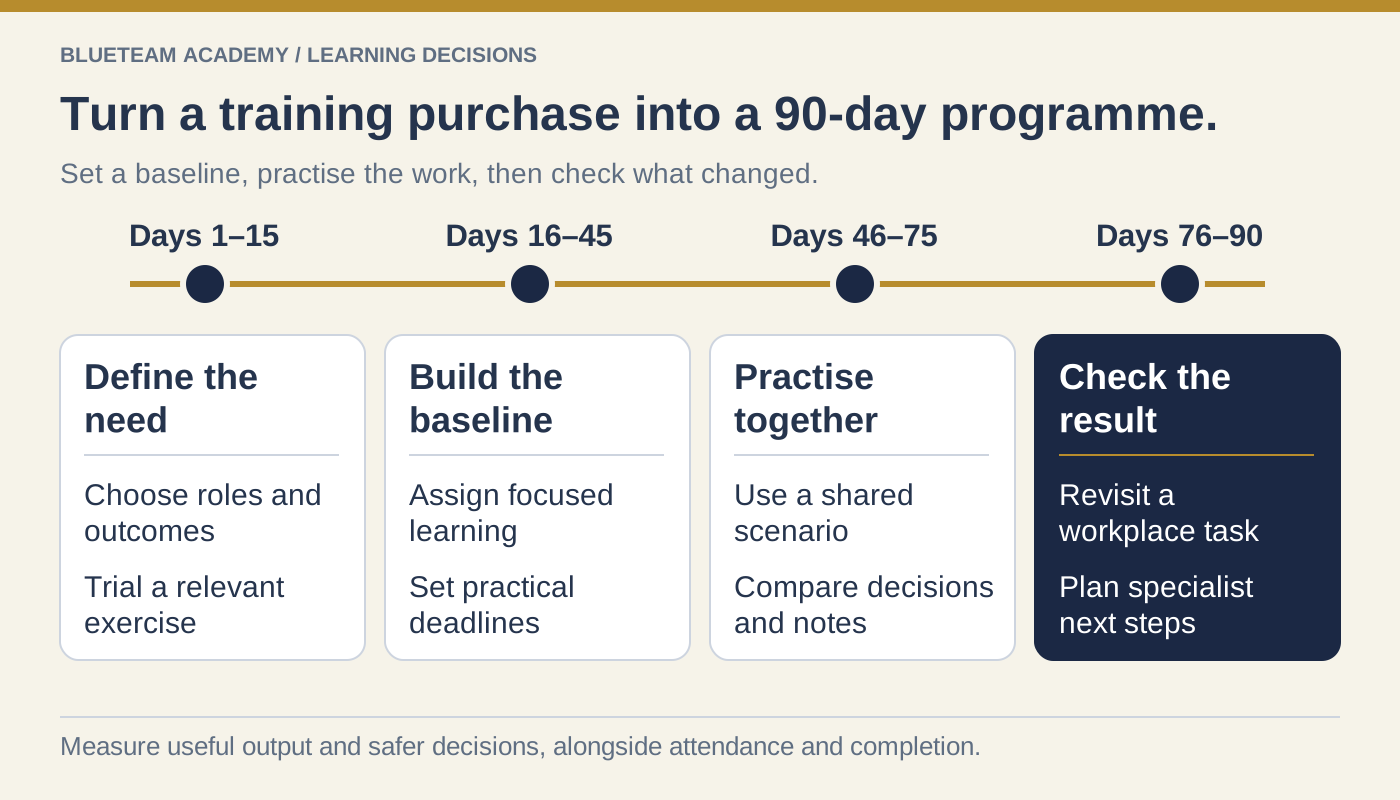
Days 16–45: complete focused learning and practice. Protect recurring study time. Ask each participant to retain one useful work product: a source-backed timeline, a response plan, an application logging requirement or a tested hardening change. Hold a short weekly discussion of what was learned and what remains difficult. Keep production data out of unapproved external AI services.
Days 46–75: apply the learning to an unfamiliar case. Use sanitized records or a controlled exercise. Avoid simply repeating the course’s exact answer. Ask the team to work together, explain uncertainties and verify the effect of a proposed response. Compare the process with the baseline without treating a faster answer as automatically better.
Days 76–90: decide what to expand. Review evidence quality, useful escalation, administrative effort, participation and total cost. Expand the courses that address a demonstrated need. Fund a specialist credential where deeper expertise is required, and avoid renewing overlapping subscriptions simply because they were approved last year.
When SANS can still be the right purchase
A fair alternatives guide should explain when the original option remains a good fit. SANS.edu may be appropriate when the learner specifically wants its academic program, the included certification pathway and the associated educational experience. SANS professional training may be appropriate when a particular course addresses an advanced requirement and the employer values its instruction and related credentials.
Before rejecting it on cost alone, obtain the relevant program information or group quote. Consider employer education benefits, applicable funding routes and what is included. Before approving it on reputation alone, specify how the learner will use the training, share appropriate knowledge and demonstrate the intended improvement.
The strongest team plan may combine a specialist investment with affordable training for the wider group. That avoids a false choice between premium development for one person and no structured learning for everyone else. BlueTeam’s role in that plan can be broad company coverage, targeted practitioner learning or both, subject to the selected course’s terms.
Choose the alternative that solves your actual training problem
For academic study, shortlist Georgia Tech and WGU alongside SANS Technology Institute. For a junior defensive practical certification, examine Centri BTL1. For technical paths, labs and recurring exercises, compare HTB Academy, OffSec and TryHackMe against the precise role and access period you need.
For affordable training across a company, BlueTeam Academy deserves a place near the top of the shortlist. Its published company licensing makes the cost of reaching ten, twenty-five, fifty or one hundred learners easy to calculate. Central assignments, deadlines, reporting and included SSO support delivery without turning every learning purchase into an individual procurement exercise. Those are useful advantages, even though they do not confer academic equivalence.
Start with the BlueTeam Academy course catalogue, inspect the AI-Assisted Incident Response & Investigation curriculum, and compare current company and course pricing. Pilot the relevant course with real learners, define the work you expect afterward and expand when the results justify it.
Questions buyers ask
What is the best alternative to SANS Technology Institute?
It depends on whether you need an academic degree, a professional certification or practical team training. Georgia Tech and WGU belong on an academic shortlist. HTB Academy, Centri BTL1, OffSec and TryHackMe address practical professional development. BlueTeam Academy is a strong choice when affordable coverage for more of the team and centrally managed courses are the main objectives.
Is BlueTeam Academy equivalent to a SANS.edu degree or GIAC certification?
No. BlueTeam Academy provides course learning and completion records under its course requirements. It does not award accredited academic degrees or GIAC credentials. Compare it as a focused learning and team-training option, and choose an academic or certification provider when that particular qualification is required.
Can a company train its whole team affordably with BlueTeam Academy?
Eligible annual company plans currently cover one selected course for up to 10, 25, 50 or 100 learners, with discounted additional eligible courses. At full use, the €1,499 first-course plan for 100 learners works out to €14.99 per learner per year before VAT. Practitioner courses have separate pricing, and larger organizations should request a quote.
Does SANS offer group discounts or enterprise administration?
Yes. SANS describes volume purchasing through its Voucher Program and centralized administration for organizations. BlueTeam Academy’s affordability argument concerns its published company-course prices and the coverage a budget can reach; it is not a claim that SANS lacks group training or enterprise capabilities.
Are the cheapest options always the best value?
No. An inexpensive unused subscription is poor value, and a completion certificate may not satisfy an employer’s credential requirement. Include staff time, practical outcomes, access periods, exams, taxes and administration in the comparison. Pilot a representative exercise and examine what learners can do afterward.
Which alternatives are useful for a junior SOC analyst?
Compare the learner’s starting skills with the actual curriculum and assessment. Centri BTL1 offers a junior defensive certification route; HTB Academy and TryHackMe provide practical paths and exercises. BlueTeam’s relevant practitioner courses can support investigation, response and IT security development. Choose a sequence that supplies the foundations before advanced casework.
Should AI capabilities influence the choice of cybersecurity training?
Yes, when AI is part of the team’s approved workflow. Look for evidence preparation, useful investigative questions, source verification, confidentiality controls and tested response actions. Do not choose solely because a provider mentions an assistant’s name, or assume competitors have no AI material. Examine a current exercise and the work it asks the learner to produce.
Sources and further reading
Official provider information and current academy pricing, checked on 10 November 2026. Recommendations are BlueTeam Academy’s editorial assessment; credential types and purchasing units differ.
- SANS Technology Institute — Tuition and funding
- SANS Technology Institute — Accreditation and authorization
- SANS Institute — Group purchasing
- Georgia Tech — Online Master of Science in Cybersecurity
- WGU — 2026–2027 tuition schedule
- WGU — IT degree tuition and fees
- BlueTeam Academy — Company pricing
- BlueTeam Academy — Course catalogue
- HTB Academy — October 2026 pricing announcement
- HTB Academy — Practical learning paths
- Centri — Blue Team Level 1
- OffSec — IR-200 and OSIR
- OffSec — Current pricing
- TryHackMe — Business learning and exercises
- TryHackMe — Business pricing guidance
BlueTeam Academy publishes this guide and sells training. Prices exclude additional fees or taxes unless explicitly stated. Check current provider terms before purchasing.